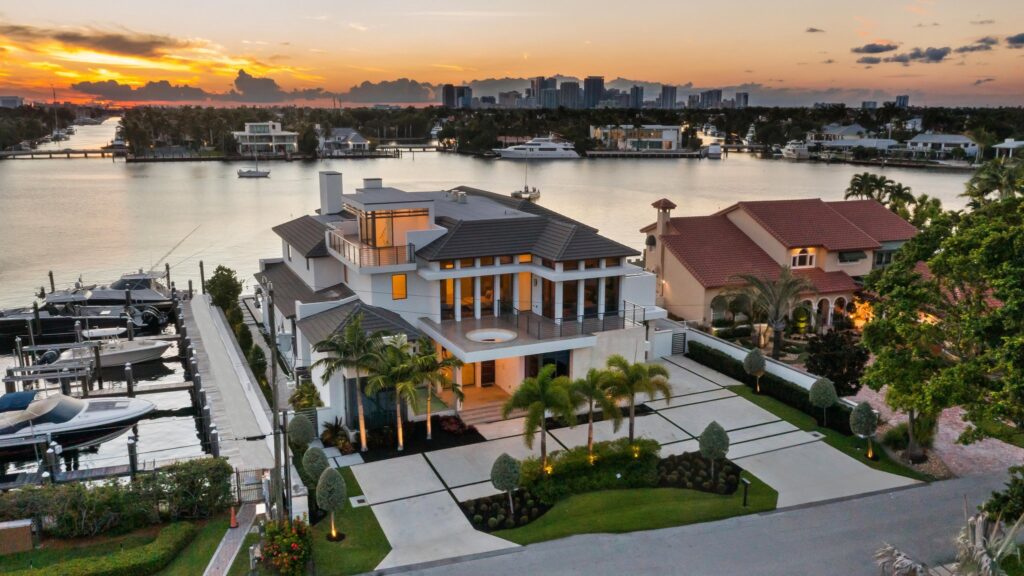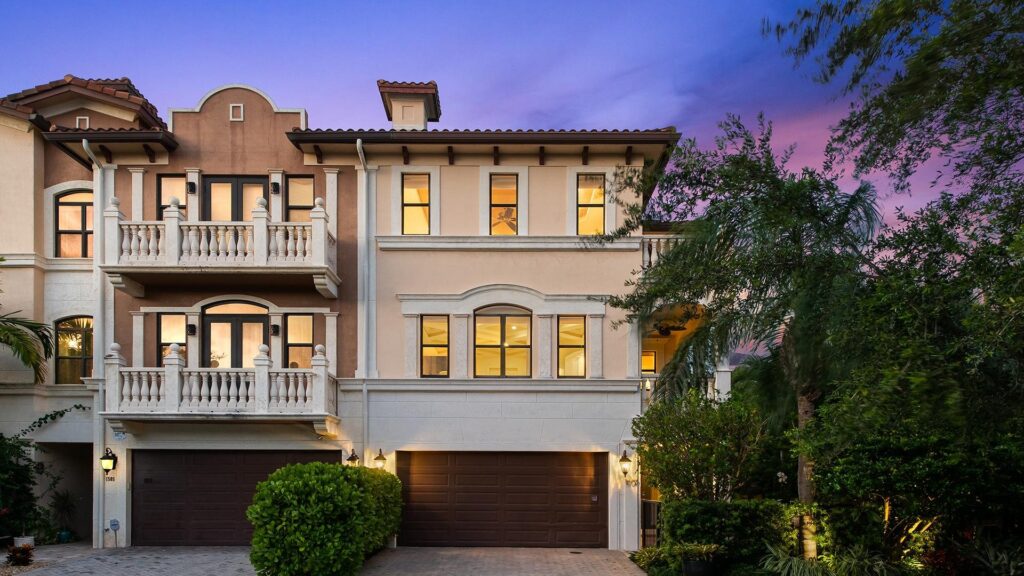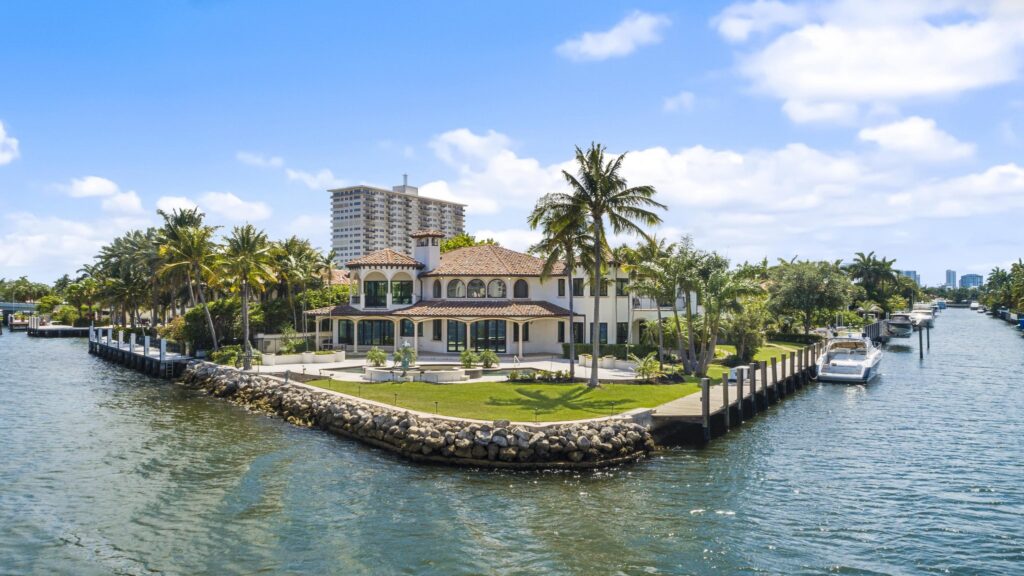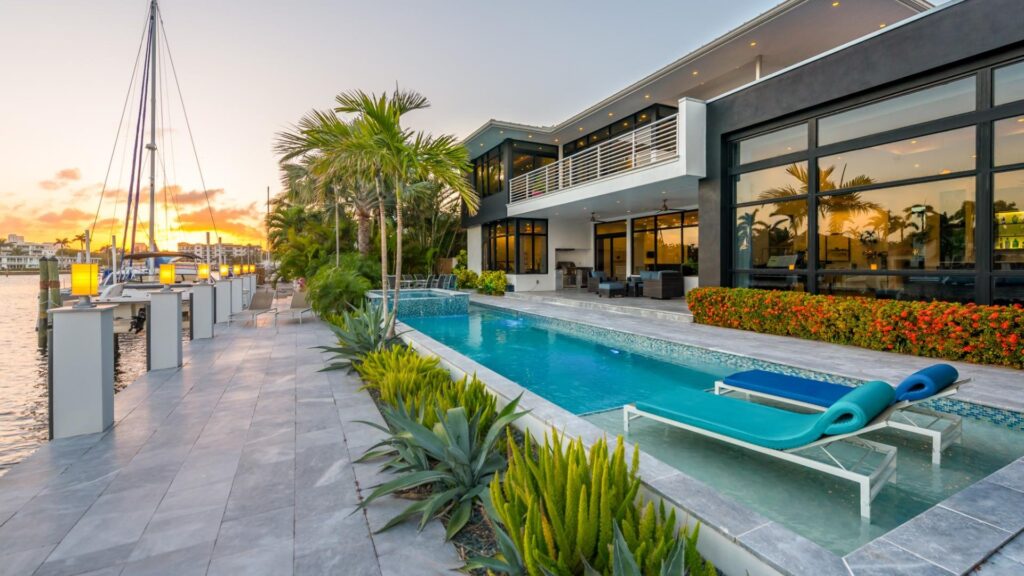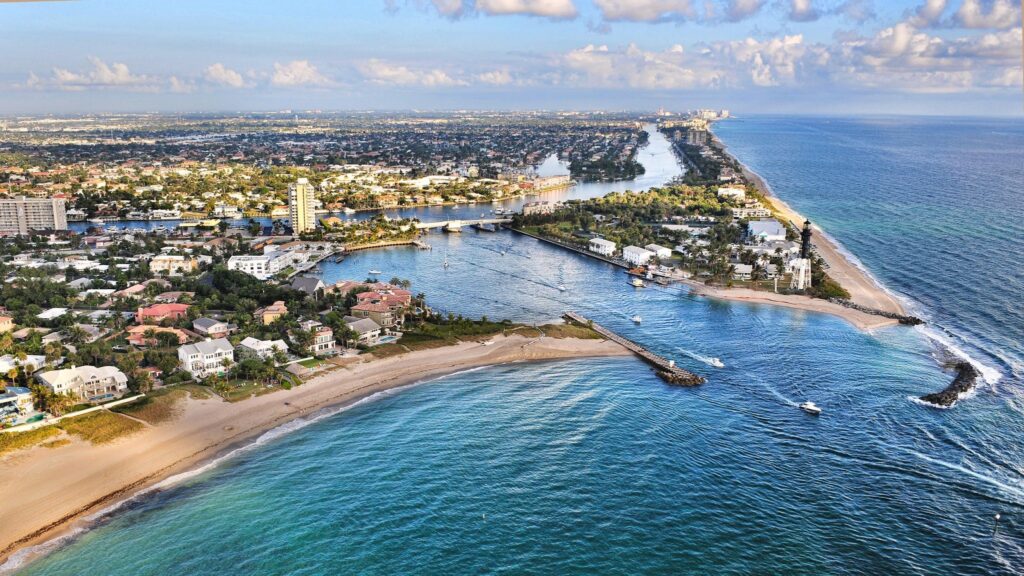
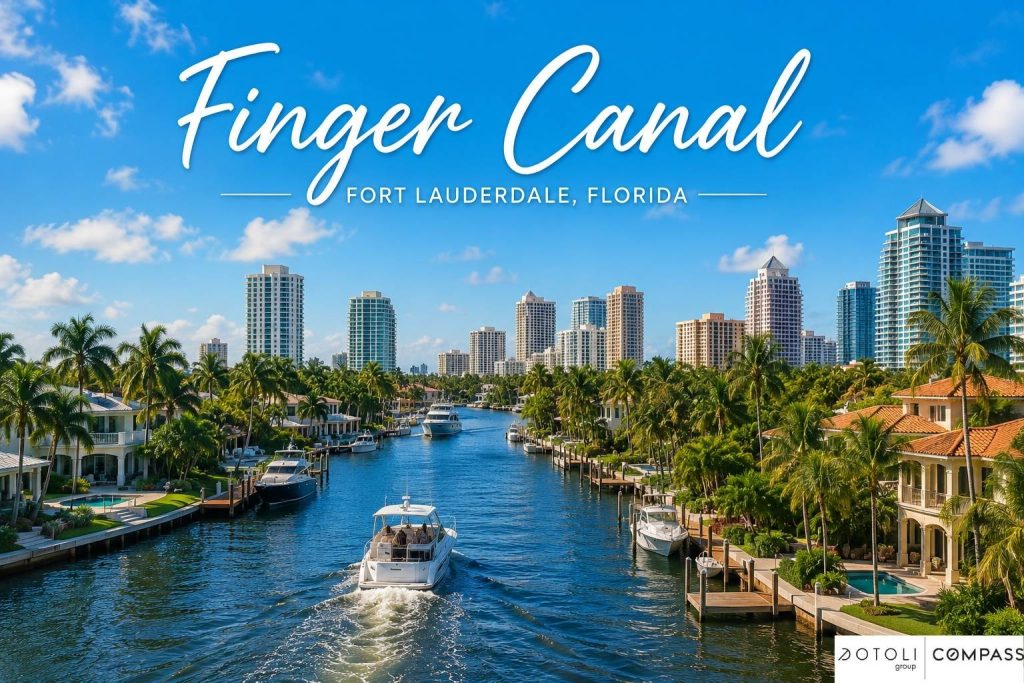

If you are researching waterfront property in Fort Lauderdale, you will come across the term finger canal in listing descriptions, neighborhood guides, and agent conversations. Most of the time, it goes undefined.
A finger canal Fort Lauderdale property sits on a narrow residential channel that branches off a main waterway, and whether that configuration works for you depends almost entirely on the size of the boat you plan to keep there.
What Is a Finger Canal
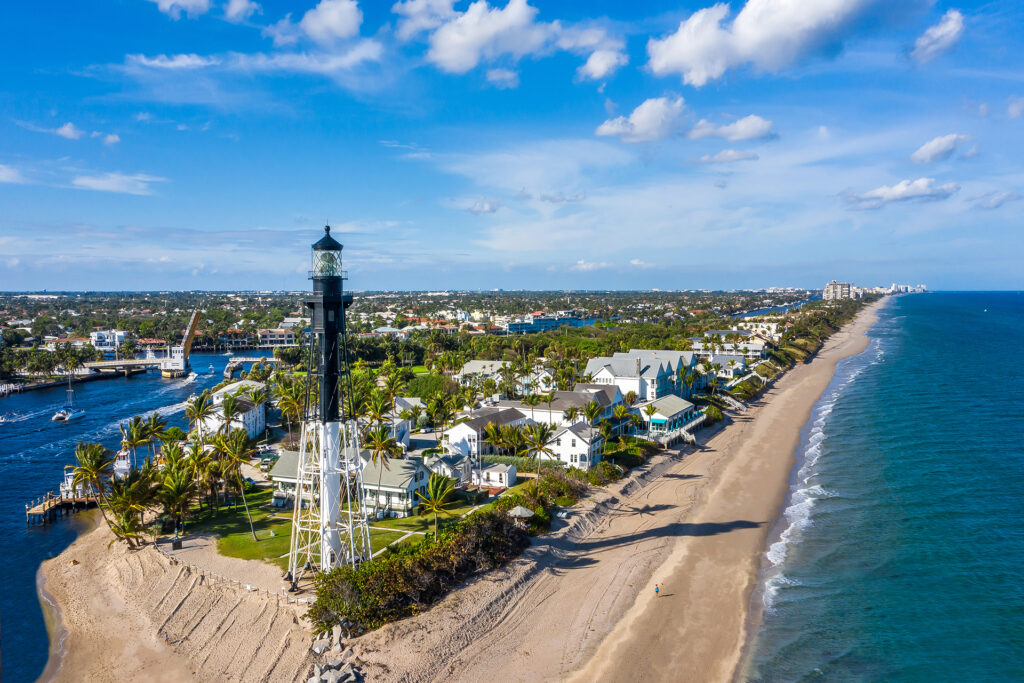
A finger canal is a narrow, dead-end canal that extends off a wider primary waterway, such as the Intracoastal Waterway or a main navigational channel.
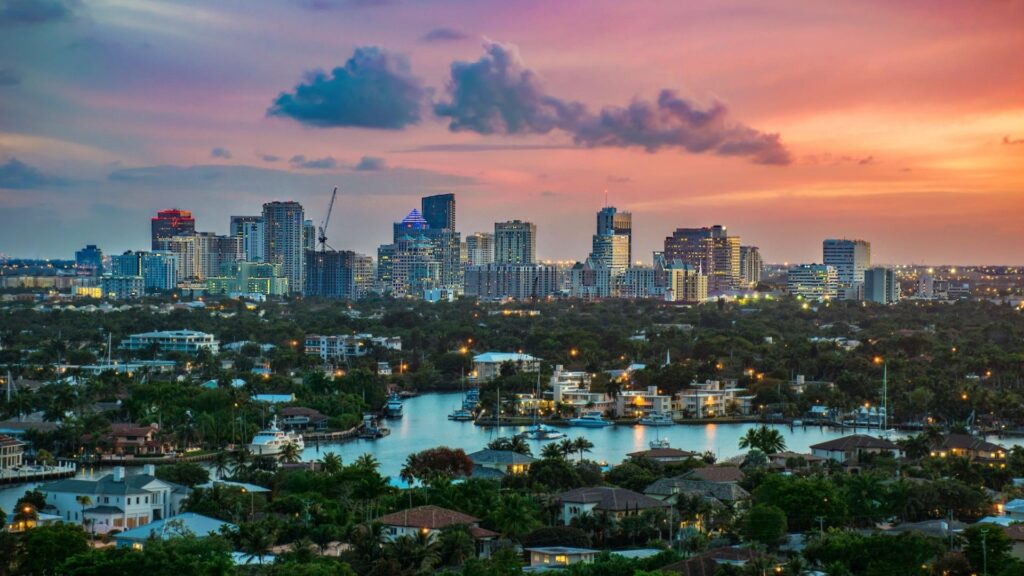
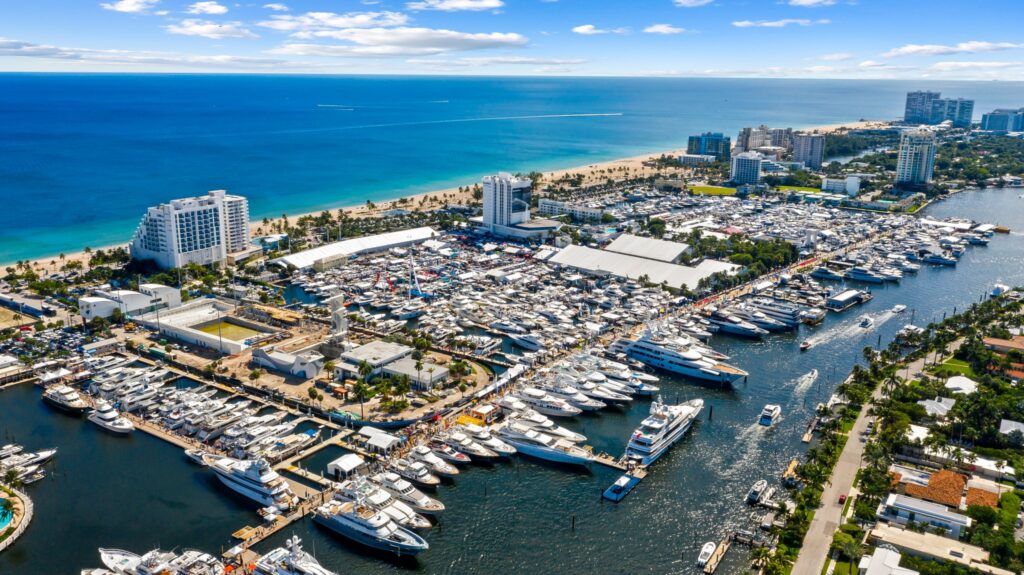
Most of Fort Lauderdale’s 165 miles of waterways consist of finger canals, giving individual properties water access without directly fronting the main waterway. Width, depth, and navigability vary significantly depending on the neighborhood and dredging history.
Why Fort Lauderdale Is Mostly Finger Canals
Fort Lauderdale earned the nickname “Venice of America” by building an extensive grid of canals through what was largely flat, low-lying land. Developers platted neighborhoods by digging narrow channels perpendicular to wider primary waterways, giving each lot a slice of water frontage.
That system works well for residential use, but it was designed for the boats of the 1950s and 1960s, not the 45-foot sportfishers and 60-foot yachts that buyers bring to these neighborhoods today.
The result is a city where access to water varies dramatically from street to street. A home two blocks from a deepwater channel may sit on a finger canal that barely accommodates a 25-foot center console at low tide. Understanding the difference before you make an offer is not optional if boating is part of your reason for buying.
What Makes a Finger Canal Different from a Wide Canal
Finger canal vs. wide canal: Fort Lauderdale is one of the most important distinctions a waterfront buyer needs to understand, and it comes down to three things: width, depth, and turning room.
Wide canals, such as those in Las Olas Isles and Seven Isles, are primary or near-primary navigational channels with substantial width and maintained depth. They were designed or dredged to accommodate larger vessels and give you room to maneuver in and out of your dock without precision docking every time.
Finger canals are narrower by design. They branch off the wider channels and terminate at a dead end, meaning there is no through traffic and limited room to turn around. A vessel that is too wide or too long for the canal cannot simply reverse out cleanly, especially on a windy day or with current running.
The City of Fort Lauderdale applies a vessel width rule: a docked vessel may not exceed 30 percent of the canal channel width.
On a narrow finger canal that is 60 feet wide, this caps your boat at 18 feet of beam. On a wider 120-foot channel, you can accommodate a vessel up to 36 feet wide. Width is the first number to confirm before you buy.
Shallow Finger Canals in Fort Lauderdale: The Depth Problem
The phrase “shallow finger canal” in Fort Lauderdale often comes up among buyers who did not do a depth check before closing. Many of the city’s residential finger canals have not been dredged since they were originally cut, and decades of sediment accumulation have considerably reduced their low-tide depth.
A canal listed at 5 feet in a decades-old survey may read 3 feet or less at mean low water today. That is workable for a kayak or a small jon boat. It is not workable for anything with a meaningful draft.
The dead-end configuration compounds the depth problem. On a through-channel, tidal flushing keeps sediment moving. In a dead-end finger canal, sediment settles and stays.
Some finger canal neighborhoods have organized dredging programs through homeowner associations or have petitioned the city for maintenance dredging, but many have not.
Before buying on any finger canal in Fort Lauderdale, you need a physical depth reading at the dock during confirmed low tide, not the figure in the listing or the NOAA chart depth for the nearby primary channel.
Which Fort Lauderdale Neighborhoods Have Finger Canals
Almost every canal neighborhood in Fort Lauderdale has some finger canal inventory. The distinction is how wide and how deep those canals run compared to the nearby primary channels.
Neighborhoods like Coral Ridge, Rio Vista, and parts of Victoria Park have extensive finger canal networks. Some of those canals are wide and maintained well enough for mid-size vessels. Others are narrow and shallow and best suited for small powerboats or paddlecraft.
Las Olas Isles and Seven Isles are often discussed as alternatives because their primary channels are wider and deeper, but even within those neighborhoods, individual lots vary.
A home at the mouth of a finger canal where it meets a primary channel has different access than a home at the dead end of the same finger canal three hundred feet deeper into the neighborhood.
Knowing which specific stretch of canal a property sits on, and what the depth and width are at that dock, tells you more than the neighborhood name alone.
Fort Lauderdale Canal Neighborhoods and Boating: Matching the Canal to Your Boat
In Fort Lauderdale, boating access in canal neighborhoods depends on matching the right canal to the right vessel. Here is a practical breakdown:
Small powerboats and center consoles under 25 feet with a shallow draft can navigate most finger canals in Fort Lauderdale, including narrower and shallower ones, as long as there is at least 4 feet of depth at low tide and enough width to dock and exit without issue.
Mid-size boats between 25 and 40 feet need more care. You want a finger canal with at least 5 to 6 feet at low tide, a width of 80 feet or more, and enough room at the dead end or a nearby intersection to turn around or back out with confidence.
Larger vessels above 40 feet, including sportfishers, trawlers, and express cruisers, generally do not belong on narrow finger canals. These boats need wide primary channels or near-primary channels with confirmed deepwater depth.
Trying to keep a large vessel on an undersized finger canal is a daily frustration and a real risk of hull damage or grounding. If you are buying specifically for a large boat, the conversation should start with the canal, not the house.
FAQ’s
What is a finger canal in Fort Lauderdale?
A finger canal is a narrow, dead-end residential channel branching off a main waterway. Most of Fort Lauderdale’s 165-mile canal network consists of finger canals that provide individual properties with water access without directly fronting a primary channel.
How wide are finger canals in Fort Lauderdale?
Width ranges from roughly 50 feet on the narrowest residential channels to 100 feet or more on wider canals. The city limits docked vessels to 30 percent of the canal width, so confirm the measurement before buying.
Are the finger canals in Fort Lauderdale deep enough for large boats?
Many are not. Unmaintained finger canals can drop to 3 feet or less at low tide due to sediment buildup. Always get a physical depth reading at the dock during confirmed low tide before closing.
What is the difference between a finger canal and a wide canal in Fort Lauderdale?
Wide canals are primary navigational channels with maintained depths and sufficient clearance for large vessels to maneuver. Finger canals are narrower dead-end branches off those channels, typically shallower and with less maneuvering room for larger boats.
Can I dredge a finger canal in front of my Fort Lauderdale home?
Yes, but it requires permits from the Florida DEP and potentially the Army Corps of Engineers. It is not quick or cheap. Confirm current depth before buying rather than planning to dredge after closing.
Which Fort Lauderdale neighborhoods are best for boaters on finger canals?
Las Olas Isles and Seven Isles have the widest and deepest finger canals in the city. Coral Ridge and Rio Vista work well for smaller vessels. The specific canal matters more than the neighborhood name.
Talk to Dotoli Group Before You Choose a Canal
The right canal for your boat is not something you can determine from a listing photo or a neighborhood name. It takes a depth reading, a width measurement, and knowledge of which canals in Fort Lauderdale have been maintained and which have not.
Dotoli Group works exclusively in this market and knows the specific canals, not just the neighborhoods.
If you are evaluating waterfront properties and want to know whether a specific canal works for your boat before you make an offer, contact Dotoli Group or explore our neighborhood guide to start in the right areas.