
Fort Lauderdale sits in Broward County, home to approximately 1.9 million residents, with I-95 as the primary north-south artery through the entire South Florida corridor from Miami to Palm Beach.
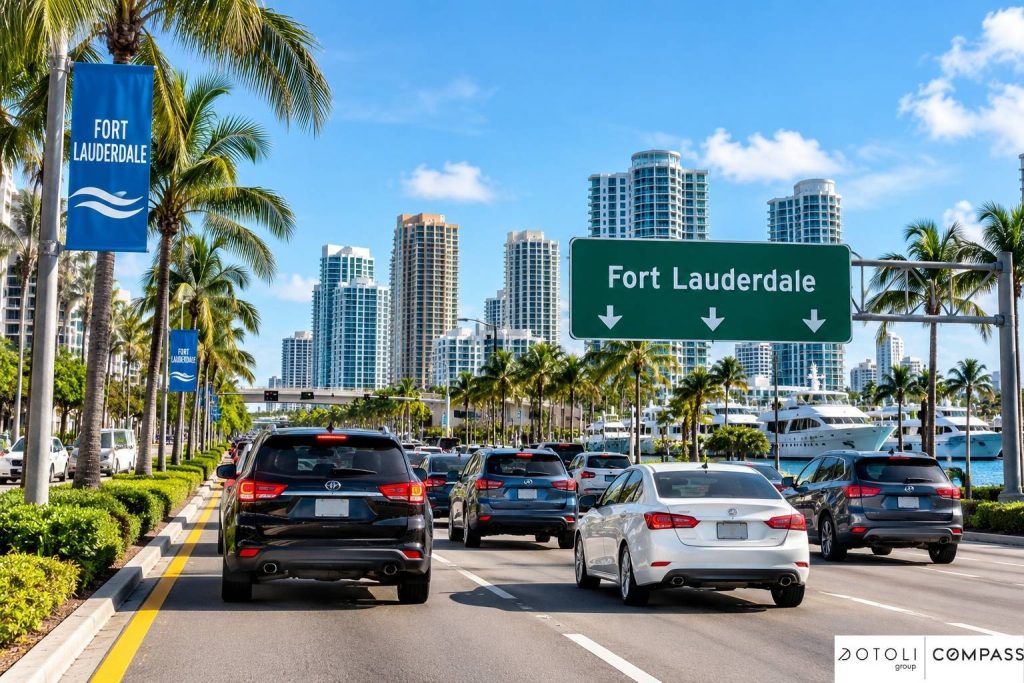
Traffic here is real and predictable. It follows consistent patterns by time of day and by route, which means buyers who choose the right neighborhood for their commute rarely find it a problem. Buyers who don’t consider it before purchasing often regret it.
This guide covers peak hours, the specific roads that matter, which neighborhoods have the shortest downtown commutes, and what public transportation actually looks like for residents who want an alternative to driving.
When Is Fort Lauderdale Traffic at Its Worst?
Weekday rush hour in Fort Lauderdale runs 7:30 to 9:30 AM and 3:30 to 6:30 PM. The afternoon window is consistently worse than the morning. I-95 southbound into Miami and northbound out of it during those windows can add 20 to 40 minutes to any trip that uses the highway.
Weekend congestion concentrates between 11:00 AM and 2:00 PM, primarily on A1A through the beach corridor and on Las Olas Boulevard.
The worst single corridor in the metro is I-95 between Fort Lauderdale and Miami from 4:00 to 6:30 PM. Buyers who need to commute to Miami regularly should factor that into neighborhood selection, not just property price.
A home in Harbor Beach that puts you 20 minutes from downtown Fort Lauderdale still puts you 45 to 60 minutes from Brickell during peak hours.
Which Fort Lauderdale Neighborhoods Have the Shortest Commutes?
For buyers whose primary destination is downtown Fort Lauderdale or the Las Olas corridor, the eastern neighborhoods are the clearest winners. Distance from downtown matters far less than which roads you use for the commute.
Eastern Neighborhoods: Victoria Park, Rio Vista, Las Olas Isles
Victoria Park, Rio Vista, and Las Olas Isles sit within 1 to 3 miles of downtown Fort Lauderdale. Outside rush hour, the drive is 5 to 10 minutes on surface streets. During peak weekday hours, the same trip takes 15 to 20 minutes, entirely on US-1 or city streets with no highway exposure.
These neighborhoods are also the most walkable in the city, meaning many residents reach Las Olas Boulevard, the Riverwalk, and downtown employment on foot or by bike without driving at all.
For buyers evaluating living in Fort Lauderdale with a downtown or Las Olas-area employer, these three neighborhoods eliminate the highway commute.
Mid-City Neighborhoods: Coral Ridge, Wilton Manors, Oakland Park
Coral Ridge, Wilton Manors, and Oakland Park sit 3 to 6 miles north of downtown. The commute runs on US-1 or Federal Highway, which during peak hours adds 10 to 15 minutes over the off-peak baseline.
These neighborhoods offer buyers more square footage and lot size than eastern neighborhoods at lower price points, with a manageable commute trade-off for most buyers.
Western Broward: Davie, Plantation, Sunrise
Western Broward neighborhoods access downtown Fort Lauderdale primarily via I-595 eastbound to I-95 or US-1. Off-peak, the drive runs 25 to 35 minutes. During the 4:00 to 6:30 PM window, I-595 eastbound backs up significantly, and the same trip can run 50 to 70 minutes.
Buyers relocating from suburban markets who are accustomed to highway commutes often underestimate this window. Western Broward works well for buyers whose employer is in western Broward, not for buyers commuting east daily.
What Are the Main Roads and Alternate Routes in Fort Lauderdale?
I-95 and US-1
I-95 is the fastest route between Fort Lauderdale, Miami, and Palm Beach outside of peak hours. During peak hours, US-1 (Federal Highway), which runs parallel to I-95, is often faster for trips within Broward County because it avoids the on-ramp backups that add time to I-95 entries.
For buyers whose commute stays within Fort Lauderdale or northern Broward, US-1 is the primary surface road and performs reliably even during rush hour.
I-595 and A1A
I-595 connects I-95 near downtown Fort Lauderdale to I-75 in western Broward and serves as the primary east-west corridor. It is the main route for buyers in Davie, Plantation, and Weston accessing the airport, Port Everglades, and downtown.
A1A runs the entire length of the beach corridor from Hollywood north through Fort Lauderdale Beach and Lauderdale-by-the-Sea.
It is the slowest route at midday on weekends but the most direct for beach-corridor residents who want to avoid inland congestion on local trips.
What Public Transportation Does Fort Lauderdale Offer?
For buyers who want to reduce or eliminate driving, Fort Lauderdale has three distinct transit options worth evaluating before purchase.
Brightline
Brightline operates express train service connecting downtown Fort Lauderdale to Miami (about 30 minutes), Boca Raton (about 20 minutes), and West Palm Beach (about 40 minutes). The Fort Lauderdale station is at the Brightline terminal downtown, adjacent to the Las Olas Boulevard corridor.
For buyers who regularly commute to Miami’s financial district or Brickell, Brightline eliminates the I-95 southbound commute. Monthly passes are available. The service runs frequently throughout the day with no transfers required.
Broward County Transit and Tri-Rail
Broward County Transit (BCT) operates bus routes throughout the county, connecting major corridors including US-1, Broward Boulevard, and Commercial Boulevard.
Tri-Rail is a commuter rail line running from West Palm Beach to Miami, with a Fort Lauderdale stop at Cypress Creek Road in the northern part of the city, and is primarily useful for buyers commuting south toward Miami or north toward Boca Raton and Palm Beach.
The full Fort Lauderdale public transportation breakdown covers routes, schedules, and pass options in detail.
Water Taxi
The Fort Lauderdale Water Taxi operates on the Intracoastal Waterway and New River with 12 stops connecting the beach, Las Olas, and downtown. Day passes are $32 for adults.
For residents in waterfront neighborhoods including Las Olas Isles, Rio Vista, and the beach corridor, the Water Taxi is a practical daily option for reaching Las Olas Boulevard restaurants, the Broward Center, and downtown without driving.
What Should Buyers Consider About Traffic When Choosing a Neighborhood?
Traffic tolerance is personal, but three questions give buyers a practical framework before committing to a neighborhood.
Where is your primary destination on weekdays?
If it is downtown Fort Lauderdale or Las Olas, the eastern neighborhoods eliminate the worst of the commute.
If it is Miami’s Brickell or downtown, Brightline from downtown Fort Lauderdale changes the math entirely and makes the eastern neighborhoods the right choice regardless of driving time.
If you work in western Broward, western Broward neighborhoods are the logical answer.
How often do you travel to Miami?
Buyers who make that trip two or more times per week should either live near a Brightline station or price the commute time into their location decision.
The I-95 southbound peak window is not manageable daily for most buyers who value their time.
Do you need a car for daily errands?
Victoria Park, Rio Vista, and Las Olas Isles are the only Fort Lauderdale neighborhoods where a car is optional for daily life.
These neighborhoods have some of the highest walkability scores in Broward County. Buyers who want to reduce car dependency specifically target these three addresses.
For buyers still forming their picture of daily life in Fort Lauderdale, ” Is Fort Lauderdale a good place to live covers the full quality-of-life picture beyond commute, and moving to Fort Lauderdale provides the practical relocation context buyers typically need alongside neighborhood research.
Looking to Buy Home?
Dotoli Group works exclusively in Fort Lauderdale residential real estate. If commute time to a specific destination matters, please tell us at the start of your search. We will filter your options around addresses that fit your daily routine.