
Property taxes on a single-family home in Fort Lauderdale are calculated by multiplying the property’s taxable value, which is the assessed value minus any applicable exemptions, by the millage rate set by Broward County and the City of Fort Lauderdale.
The combined millage rate for most Fort Lauderdale properties is approximately 19-21 mills, meaning roughly $19–$21 in tax per $1,000 of taxable value.
For a home purchased at $1.5 million, that translates to an estimated annual tax bill between $28,500 and $31,500 before exemptions.
Why Understanding Your Property Tax Bill Matters Before You Close
Property taxes in Fort Lauderdale are one of the highest ongoing costs of homeownership, and for out-of-state buyers, especially, they often come as a surprise.
Unlike many Northern states that keep assessed values well below market value, Florida resets assessed value to the purchase price when a property changes hands. That means the tax bill you inherit from the current owner is almost certainly not the bill you’ll receive in your first year.
Understanding how the calculation works and what tools exist to reduce it can mean the difference of thousands of dollars per year.
Florida’s Homestead Exemption is one of the most valuable tax benefits available to homeowners in the country, and many buyers miss it simply because they don’t know to apply for it.
Step 1: How the Broward County Property Appraiser Sets Your Assessed Value
The Broward County Property Appraiser is responsible for determining the assessed value of every property in the county each year.
For a property that was recently sold, the assessed value is set equal to the purchase price in the first year of ownership. This is known as a reset or recapture of market value.
This is the most important thing out-of-state buyers need to understand. If you’re buying a home that’s been owned by the same family for 20 years, their current assessed value may be dramatically lower than what you pay because Florida’s Save Our Homes cap limits annual increases to 3% or the Consumer Price Index (CPI), whichever is lower, for existing homestead properties. The moment you buy, that cap resets to your purchase price.
Real-World Example: A seller bought their Coral Ridge home in 2005 for $600,000. Due to the Save Our Homes cap, their assessed value in 2025 might be around $820,000, even if you’re paying $2,100,000. Your first-year assessed value will be $2,100,000. Their annual tax bill and yours will look completely different.
Step 2: Exemptions That Reduce Your Taxable Value
Once the assessed value is established, certain exemptions can reduce it before the millage rate is applied. The most significant for individual homeowners is Florida’s Homestead Exemption.
The Florida Homestead Exemption
If this property will be your primary residence, you’re entitled to Florida’s Homestead Exemption, a $50,000 reduction in your assessed value for property tax purposes. The exemption is split into two parts: the first $25,000 applies to all taxing authorities, and the second $25,000 applies to all authorities except the school board levy.
In practical terms, this saves most Fort Lauderdale homeowners between $900 and $1,100 per year on their property tax bill, depending on the combined millage rate.
You must apply for the exemption with the Broward County Property Appraiser’s office by March 1st of the year following your purchase. Applications are available online at bcpa.net.
Additional Exemptions Worth Knowing
Beyond the standard Homestead Exemption, additional reductions may be available depending on your circumstances.
A Senior Citizen Exemption is available for homeowners aged 65 and older who meet income requirements. There is also a Disability Exemption for qualified individuals, and a
Widow/Widower Exemption of $500. Veterans with service-connected disabilities may qualify for additional or full exemptions depending on the disability rating. If any of these apply to your situation, it’s worth confirming eligibility directly with the Broward County Property Appraiser’s office.
Step 3: How the Millage Rate Is Applied
A millage rate is the tax rate expressed in mills, where one mill equals $1 of tax for every $1,000 of taxable value. Your total property tax bill is the sum of millage rates charged by multiple taxing authorities, not just the county or the city, but a collection of local government bodies, each setting its own rate annually.
For a property in the City of Fort Lauderdale within Broward County, the combined millage rate typically comes from the following authorities:
| Taxing Authority | Approx. Millage |
| Broward County General Fund | ~5.66 mills |
| Broward County School Board | ~6.68 mills |
| South Florida Water Management District | ~0.10 mills |
| City of Fort Lauderdale | ~4.49 mills |
| Children’s Services Council | ~0.50 mills |
| Other Special Districts (varies) | ~2–3 mills |
| ESTIMATED TOTAL (Fort Lauderdale) | ~19–21 mills |
These rates are set annually in the fall and are subject to change. The figures above reflect approximate 2025 rates and are provided for illustrative purposes.
Always confirm the current rate with the Broward County Tax Collector at broward.county-taxes.com before budgeting for a specific property.
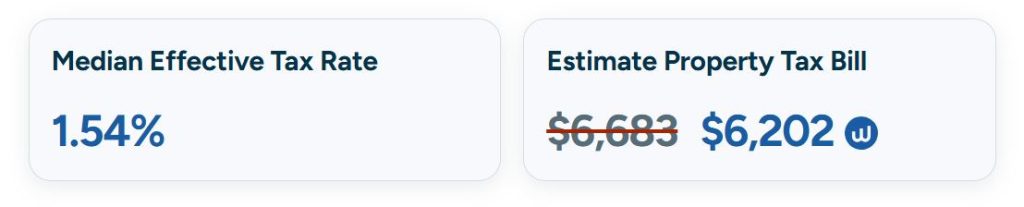
Property Tax Rates Across Fort Lauderdale, Broward County, Florida
According to recent study
Median Effective Fort Lauderdale Tax Rate: 1.54%
Median Effective Broward County Tax Rate: 1.44%
Median Effective Florida Tax Rate: 1.10%
Median Effective United States Tax Rate: 1.02%
The Property Tax Formula
THE PROPERTY TAX FORMULA
(Assessed Value − Exemptions) × Millage Rate = Annual Property Tax
The millage rate is expressed per $1,000 of taxable value
Sample Calculation: $1,500,000 Home in Fort Lauderdale
| Without Homestead | With Homestead | |
| Purchase Price | $1,500,000 | $1,500,000 |
| Assessed Value | $1,500,000 | $1,500,000 |
| Exemption | $0 | −$50,000 |
| Taxable Value | $1,500,000 | $1,450,000 |
| Millage Rate (approx.) | ~20 mills | ~20 mills |
| Estimated Annual Tax | ~$30,000 | ~$29,000 |
Note: The figures above use an approximate combined millage rate of 20 mills for illustration. Your actual rate will depend on the specific taxing districts that apply to your property’s address.
Some neighborhoods have additional special assessment districts or community development district fees not captured in the standard millage calculation.
The Save Our Homes Cap: How Your Tax Bill Changes Over Time
Once you establish a homestead on a property, Florida’s Save Our Homes amendment limits how much the assessed value can increase each year to the lesser of 3% or the prior year’s CPI change. This is enormously valuable over time; it means your tax bill grows slowly even as Fort Lauderdale’s real estate market appreciates.
By contrast, in your first year of ownership after purchase, there is no cap; your assessed value is the full purchase price. This one-year adjustment can create a noticeable gap between what you budgeted and what you actually receive on the November tax bill. The gap closes over the following years as the cap kicks in.
Planning Tip: When budgeting for year-one ownership costs, always calculate your tax estimate using the full purchase price as the assessed value, not the current owner’s tax bill. For a $2M home, the difference can easily be $10,000–$20,000 more than the seller was paying.
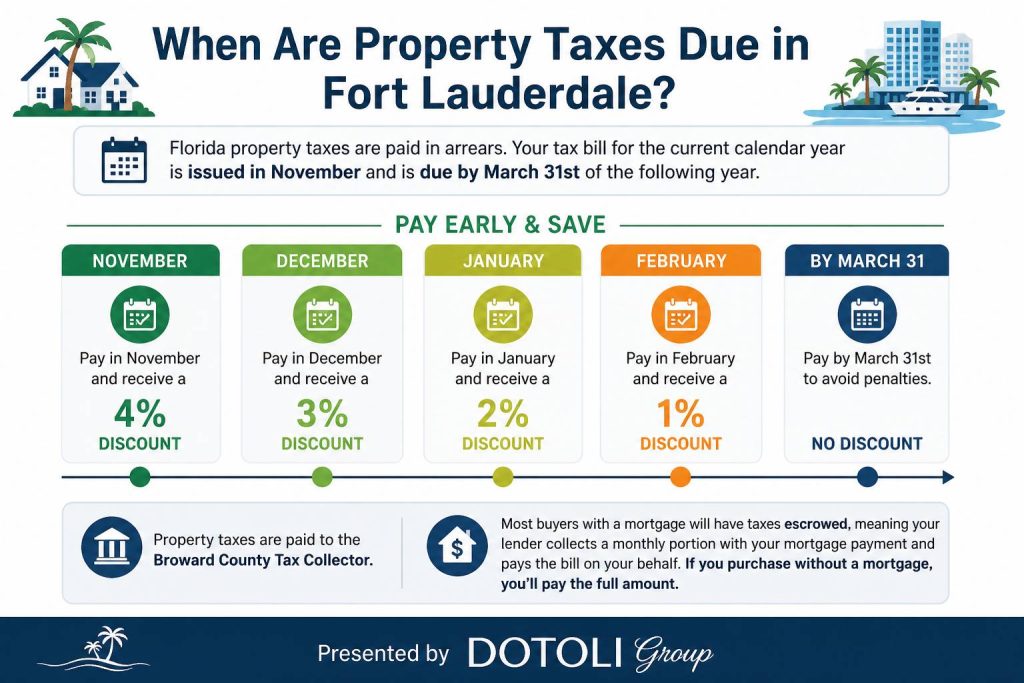
When Are Property Taxes Due in Fort Lauderdale?
Florida property taxes are paid in arrears. Your tax bill for the current calendar year is issued in November and is due by March 31st of the following year. Florida incentivizes early payment with a discount structure: pay in November and receive a 4% discount; pay in December and receive a 3% discount; pay in January and receive a 2% discount; and pay in February and receive a 1% discount. Paying by the March 31st deadline incurs no discount but avoids penalties.
Property taxes are paid to the Broward County Tax Collector. Most buyers with a mortgage will have taxes escrowed, meaning your lender collects a monthly portion with your mortgage payment and pays the bill on your behalf. If you purchase without a mortgage, you’ll pay the full amount.
Property Tax Proration at Closing: What Buyers and Sellers Split
In a Florida real estate transaction, property taxes are prorated at closing based on how many days of the tax year each party owns the property. Because Florida taxes are paid in arrears, sellers typically owe buyers a credit for the portion of the year they owned the property up to the closing date.
Your closing disclosure will clearly show this proration. On a $1.5M purchase closing in July, for example, the seller would credit the buyer approximately half of the estimated annual tax bill roughly $14,000 to $15,000, which the buyer would hold to pay the November bill when it arrives.
Frequently Asked Questions
What is the property tax rate in Fort Lauderdale?
The combined millage rate for properties within the City of Fort Lauderdale typically ranges from 19 to 21 mills, depending on the specific address and applicable taxing districts.
This equals approximately $19–$21 in annual tax per $1,000 of taxable value. The rate is set each fall and can shift slightly year to year as each taxing authority sets its budget.
How do I apply for the Homestead Exemption in Fort Lauderdale?
You apply through the Broward County Property Appraiser’s office at bcpa.net. The deadline is March 1st of the year following your purchase, so if you close in October 2025, you must apply by March 1, 2026, to receive the exemption on your 2026 tax bill.
The exemption is not automatic and requires a one-time application with proof of primary residency (e.g., a Florida driver’s license, vehicle registration, voter registration, etc.).
Will my property taxes be the same as the current owner’s?
No, and this is one of the most common surprises for new buyers in Florida. When a property is sold, the assessed value resets to the purchase price, which is often significantly higher than the previous owner’s capped assessed value.
Your first-year tax bill will be based entirely on what you paid, not on what the seller paid. Always calculate your tax estimate using the full purchase price.
Are there any special assessment fees beyond the regular property tax?
Yes, some properties in Fort Lauderdale are subject to special assessment districts, stormwater fees, solid waste fees, or community development district (CDD) charges that appear either on the tax bill or as separate line items.
These are address-specific and can add several hundred to several thousand dollars per year. Always request a full disclosure of all recurring fees from the seller before closing.
How is taxable value different from assessed value?
Assessed value is the value set by the Broward County Property Appraiser for your property. Taxable value is assessed value minus any exemptions you qualify for (such as the Homestead Exemption).
The millage rate is applied to the taxable value, so the more exemptions you have, the lower your final tax bill. The difference between assessed value and taxable value is the amount your exemptions have reduced the tax base.
Can I appeal my property’s assessed value in Broward County?
Yes. If you believe the Broward County Property Appraiser has overvalued your property, you can file a petition with the Value Adjustment Board (VAB) by the deadline indicated on your TRIM (Truth in Millage) notice, which is mailed in August.
You’ll need to provide comparable sales data or other evidence supporting a lower value. Many homeowners successfully reduce their assessment this way, particularly in years following rapid market appreciation.
Have Questions About Property Taxes Before You Buy?
The Dotoli Group helps buyers navigate every financial detail of purchasing a single-family home in Fort Lauderdale from understanding your first-year tax bill to filing your Homestead Exemption correctly.
We’ve helped hundreds of buyers in Las Olas Isles, Coral Ridge, Victoria Park, Seven Isles, and Rio Vista close with confidence.
✔ Local experts — we know every neighborhood, street, and school zone
✔ Transparent guidance on taxes, insurance, and total ownership costs
✔ No pressure — just honest, expert advice from people who live here
Schedule Your Free Buyer Consultation Today
📱 (954)-539-9854 | 🌐 joshdotoligroup.com | 📧 josh@joshdotoligroup.com