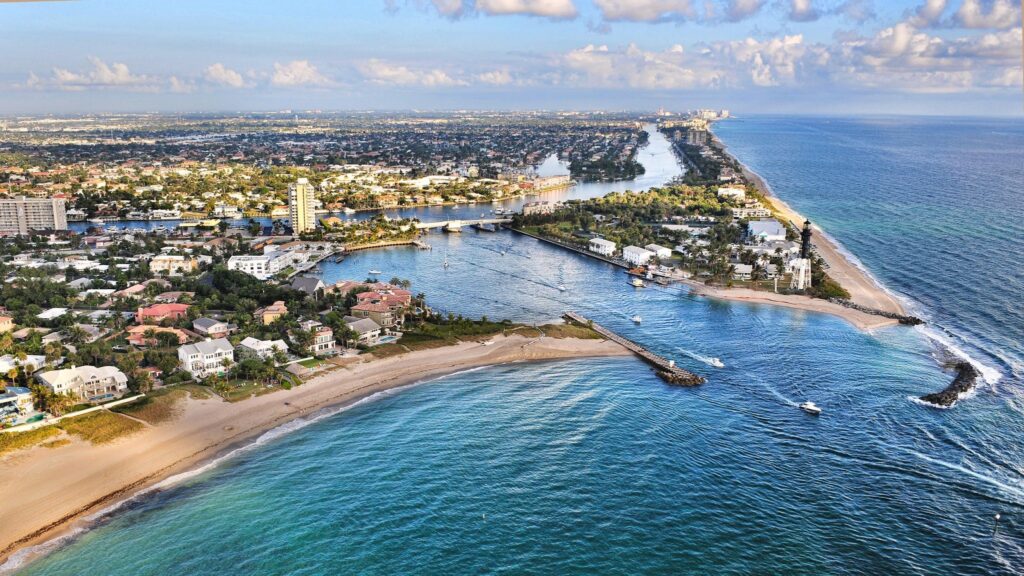
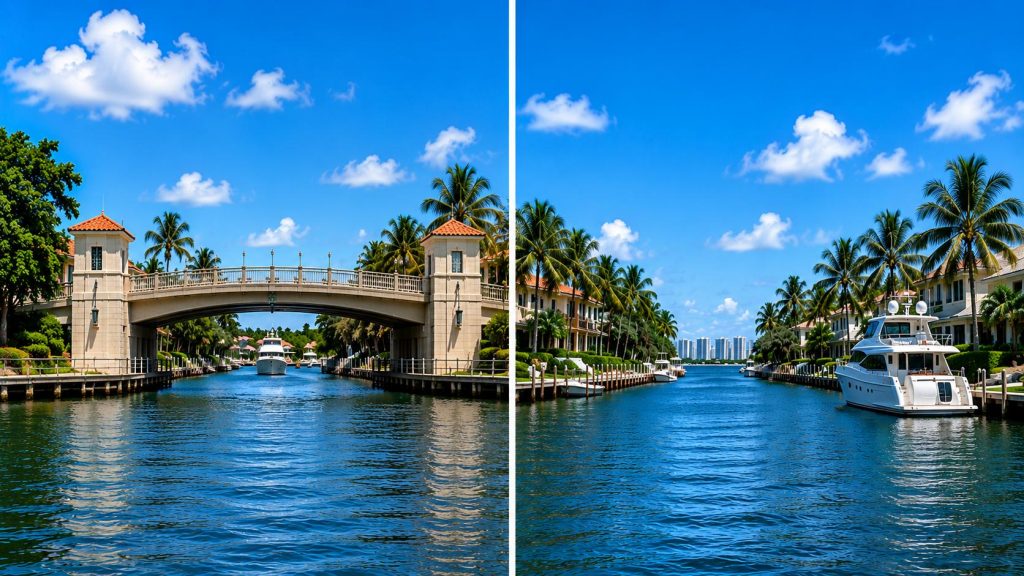

If you own a yacht and you’re shopping for a canal home, the single most important question is fixed bridge vs. no-bridge, and it will determine which Fort Lauderdale properties you can actually consider. A home with a stunning dock and deep water means nothing if your vessel cannot physically clear the bridges between that dock and the open ocean.
Most fixed bridges in Fort Lauderdale’s canal system sit at just 14 to 17 feet of vertical clearance at mean high water. At the same time, properties with true no-fixed-bridge ocean access can accommodate vessels of virtually any height.
Quick Answer
Fixed bridge homes sit on canals where one or more bridges with a set height limit, typically 14 to 17 feet at mean high water, stand between the property and the ocean. No-bridge homes have a clear path to open water with no height restriction. For yacht owners with masts, towers, or flybridges, no-bridge access is almost always the right choice.
What Is the Difference Between Fixed Bridge and No-Bridge Homes in Fort Lauderdale?
A fixed-bridge home sits on a canal where the only route to the ocean passes under a stationary bridge with a fixed vertical clearance. A no-bridge home has either direct frontage on the Intracoastal Waterway or a canal route to the ocean with no bridge crossing at all.
The practical difference comes down to one number: your vessel’s overall height versus the lowest bridge clearance on your route to open water.
For a deeper breakdown of how bridge clearance affects canal property value across Fort Lauderdale, see our guide to deep water vs. fixed bridge canal homes.
How Tall Are Fixed Bridges in Fort Lauderdale’s Canal System?
Most fixed bridges throughout Fort Lauderdale’s canal system have vertical clearances of approximately 14 to 17 feet at mean high water.
In comparison, clearances across the broader Intracoastal Waterway corridor can range from 21 to 56 feet depending on the specific crossing, according to a Fort Lauderdale bridge guide for boaters.
Within neighborhoods like Las Olas Isles, two key drawbridges, the Las Olas Bridge and the 17th Street Causeway Bridge, also affect access and operate on fixed schedules rather than opening on demand.
For context, most sailboats and many sport-fishing or motor yachts with enclosed flybridges, antennas, or radar arches exceed 17 feet in overall height. If your vessel falls into this category, a fixed bridge route can permanently block your access to the ocean from that property.
Which Yacht Sizes and Types Are Most Affected by Fixed Bridges?
Vessels with flybridges, antenna towers, sailboat masts, or radar arches taller than the lowest bridge on their route are the most affected, regardless of the boat’s length.
A 40-foot center console with no superstructure may clear a 17-foot bridge easily, while a 32-foot sailboat with a 50-foot mast cannot pass under any fixed bridge in the city.
This is why bridge clearance, not boat length alone, should be your first filter when shopping for a yacht-friendly home. Length determines whether a canal is wide enough for your vessel under the local “30 percent rule,” where a boat’s length should not exceed roughly 30% of the canal’s width, but height determines whether you can leave the canal at all.
Which Fort Lauderdale Neighborhoods Offer True No-Fixed-Bridge Access?
Las Olas Isles, Seven Isles, and select lots in Harbor Beach and Rio Vista offer the strongest no-fixed-bridge access in Fort Lauderdale. However, clearance should always be confirmed on a sub-island and per specific lot, since not every property within these neighborhoods has the same route to open water.
Las Olas Isles
A premier yacht-owner neighborhood with wide, deep canals and direct routes toward Port Everglades and the Atlantic.
Some sub-islands and routes pass near the Las Olas Bridge and 17th Street Causeway Bridge, so buyers should confirm the specific route from any given lot before assuming unrestricted access. For a full overview of buying a home in this neighborhood, see our canal home-buying guide.
Seven Isles
Known for wide canals and deep-water dockage capable of accommodating large yachts, with many properties offering a more direct, less obstructed route to the Intracoastal than canals further inland.
Harbor Beach
A private, ocean-oriented neighborhood where select properties offer direct or near-direct ocean access without the fixed bridge crossings common in other canal neighborhoods.
Rio Vista
A mixed neighborhood where some canals offer clean ocean access while others route through fixed bridges, making lot-by-lot verification essential here more than almost anywhere else in the city.
For a broader look at how Fort Lauderdale’s main navigation channel connects to these neighborhoods, see our guide to Intracoastal Waterway homes in Fort Lauderdale.
How Do You Confirm Bridge Clearance Before Buying a Home?
Confirm clearance by getting the exact route from the property’s dock to the open ocean, then checking every bridge crossing on that route against your vessel’s actual height with antennas, radar, and outriggers extended.
Never rely on a general neighborhood reputation for “no fixed bridges,” since clearance and routing can vary significantly even within the same community.
- Get your vessel’s true overall height. Measure from the waterline to the highest fixed point, including antennas, radar arches, and outriggers, not just the hull or cabin height.
- Map the exact route from the dock to the ocean. Ask your agent or a marine surveyor to trace the specific canal route from the property to open water, not just the general direction.
- Check every bridge on that route. Confirm the vertical clearance of each bridge crossing at mean high water, since clearance is always measured at the highest tide, not low tide.
- Verify with a current bridge clearance chart. Cross-reference clearance data with NOAA nautical charts or a local marine surveyor rather than relying solely on real estate marketing materials.
- Confirm the canal width against the 30 percent rule. Even with adequate height clearance, your vessel’s length should not exceed roughly 30% of the canal’s width for safe maneuvering and docking.
What Josh Dotoli Says About Buying for Your Yacht
“I’ve had clients fall in love with a house and find out during their walkthrough that their boat won’t clear the bridge to get home. It happens more than people think, because bridge clearance isn’t something most buyers think to ask about until it’s too late. The number one thing I tell yacht owners is to give me your vessel’s exact height before we even start touring, not after you’ve picked a favorite.”
Josh Dotoli, Founder and CEO, Dotoli Group
FAQ
1. What is the difference between a fixed bridge and a no-bridge home in Fort Lauderdale?
A fixed bridge home requires passing under a stationary bridge with a set height limit to reach the ocean. A no-bridge home has direct or unobstructed access to open water. Yacht owners with tall vessels should prioritize no-bridge properties.
2. How tall are fixed bridges in Fort Lauderdale?
Most fixed bridges in Fort Lauderdale’s canal system have vertical clearances of approximately 14 to 17 feet at mean high water. However, clearances across the broader area can range from 21 to 56 feet, depending on the specific crossing.
3. Which Fort Lauderdale neighborhoods have no fixed-bridge access?
Las Olas Isles, Seven Isles, and select lots in Harbor Beach and Rio Vista offer the strongest no-fixed-bridge access. However, clearance varies by specific sub-island and lot and should always be confirmed individually.
4. How do I know if my yacht will clear a bridge?
Measure your vessel’s true overall height from the waterline to its highest fixed point, including antennas and radar, then compare that figure against the vertical clearance of every bridge on the route from the property to open water.
5. Does boat length or boat height matter more when buying a canal home?
Both matter, but for different reasons. Length determines whether the canal is wide enough under the local 30 percent rule. Height determines whether your vessel can pass under any fixed bridges on the route to the ocean at all.
6. Should I hire a marine surveyor before buying a waterfront home for my yacht?
Yes. A marine surveyor can confirm the exact route, bridge clearances, and water depth from a specific property to open water, which is more reliable than general neighborhood reputation or listing descriptions alone.
Find a Yacht-Ready Home in Fort Lauderdale
Whether you need true no-fixed-bridge ocean access for a sport-fishing yacht or a sailboat with a tall mast, Dotoli Group can match you to the right canal or Intracoastal property and verify bridge clearance before you ever set foot on the dock.