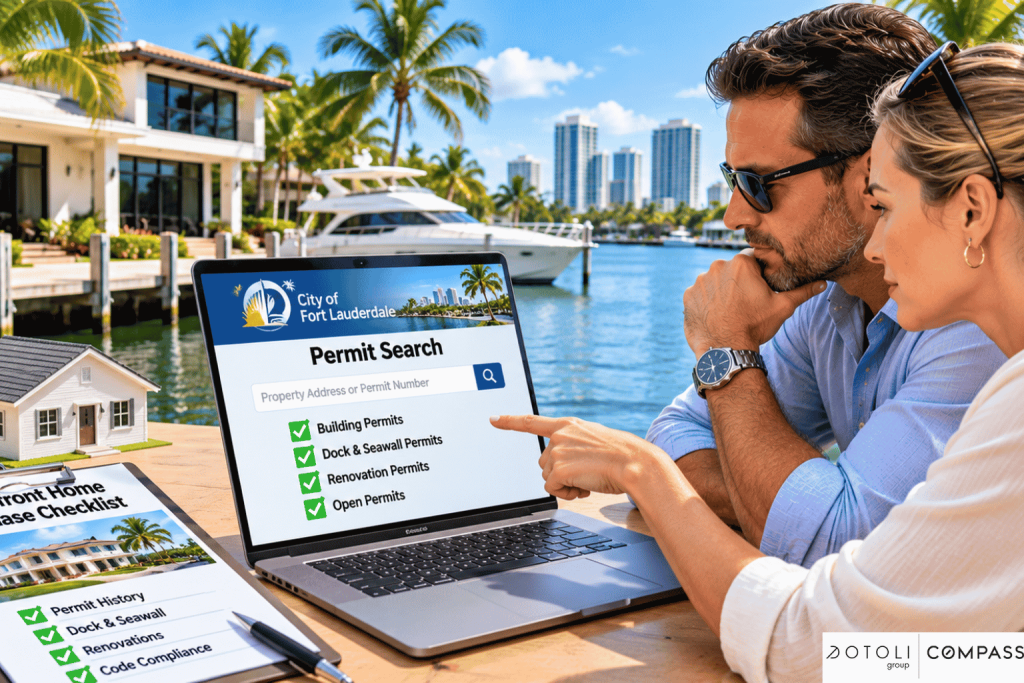

To run a Fort Lauderdale permit search, look up the address in LauderBuild, the City’s Accela portal, where anyone can see permit and code case records without an account. Then order a municipal lien search through the City’s Conduits system and request older permits from the Property Records Office, all before your inspection period ends.
Start early. Under the standard Florida Realtors and Florida Bar residential contract, the seller must fix only open or expired permits you report in writing before the inspection period ends.
This guide shows where to search, how to read what you find, and what to do about it. It is practical guidance from a real estate team, not legal advice, so run anything serious past a real estate attorney.
Is the Home Actually in the City of Fort Lauderdale?
Check this first, because it decides which building department holds the records. A “Fort Lauderdale” mailing address does not by itself mean the home is inside city limits. Fort Lauderdale’s Property Records Office only processes addresses within city limits and asks you to confirm the property’s address and folio with the Broward County Property Appraiser first (City of Fort Lauderdale, Property Records).
Look up the property on the Broward County Property Appraiser’s website and note the folio number and the municipality listed for the parcel. If it says Fort Lauderdale, use the steps below. If it names another city, search that city’s permit portal instead.
How Do You Search Permits in LauderBuild?
LauderBuild is the City of Fort Lauderdale’s Accela Citizen Access portal. The City says anyone can use it to search and view record status, so you don’t need an account to research a home (City of Fort Lauderdale, LauderBuild). Follow these steps.
- Open LauderBuild from the City’s LauderBuild page.
- Choose the permitting search. Select Permitting Services, then the search option, rather than the Global Search box, which works best when you already have a record number.
- Search by address, but keep it broad. The City notes that search entries must match its records exactly, so enter only the street number and the street name without “Street” or “Drive,” then narrow down from the results.
- Open every record on the property. For each permit, note the record number, the work described, the issue date and the current status. Pay attention to roofing, windows and doors, electrical, plumbing, pool, dock, boat lift, and seawall permits.
- Repeat the search for code cases. LauderBuild also holds code compliance records under Community Enhancement and Compliance. The City points users to LauderBuild search for code cases.
- Save what you find. Screenshot or print each record and send the list to your agent and attorney the same day, because the clock on your inspection period is already running.
The City notes that records created before October 4, 2019 are searched with a prefix added to the old record number. If an older permit does not come up, the Property Records Office can find it.
What Do Permit Statuses Mean for a Buyer?
Status labels vary slightly between record types, but every permit falls into one of three situations. Here is what each one means for you.
| What the record shows | What it means | What to do |
|---|---|---|
| Final inspection passed, permit closed | The work was inspected and approved | Nothing, beyond confirming the scope matches the house |
| Issued, with inspections still pending | The permit is open. Work may be unfinished or never inspected | Ask the seller for the contractor and the status, and report it in writing during your inspection period |
| Expired, void or abandoned | Under Section 105.4.1 of the Florida Building Code, a permit becomes invalid if work does not start within 180 days of issuance or stops for 180 days (Florida Building Code, 8th Edition (2023), Chapter 1) | Treat it like an open permit. The work may need a new permit and inspections |
Give an open roofing or window permit extra attention. Roof and opening-protection details come up in the inspections insurers ask for, and our guide to wind mitigation and 4-point inspections explains how.
What Does a Builder Look For in the Permit History?
Josh Dotoli builds waterfront homes in Fort Lauderdale through DOTOLI Development, so we read a permit history the way a builder does: as a record of what was done to the house and what was never inspected.
Where Are Older Fort Lauderdale Permit Records Kept?
For permits and plans that are not in LauderBuild, contact the City’s Property Records Office. It keeps digital and microfilm records of building permits and plans for properties in the city. The details below are from the City’s Property Records page, checked November 12, 2026.
- How to request: email PropertyRecords@fortlauderdale.gov with the address and folio number. Some requests need an in-person visit.
- Hours: Monday through Friday, 8 a.m. to 4 p.m., with microfilm viewing and copying from 8 a.m. to 3 p.m.
- Response time: The City asks you to allow up to 48 hours.
- Cost: Research is $20 per hour, or $5 per 15 minutes, plus copies, for example, $0.15 per letter-size page and $2.00 per microfilm page. Fees can change, so confirm them when you request.
The original plans are especially useful for an older waterfront home because they show the permitted footprint you can compare with what stands today.
How Do You Check Code Violations and Liens on a Fort Lauderdale Home?
Search LauderBuild for code cases first, then order a municipal lien search. The City provides lien reports through a system called Conduits, run by Net Assets Corporation (City of Fort Lauderdale, Lien Search). Title companies, escrow agents, and search agencies usually request it, and the City also offers one-time access for individuals. In most purchases your title company orders it, so ask them to do it early rather than days before closing.
The lien search matters because a code fine can follow the property, not the person. Under Florida Statutes Section 162.09, once a code enforcement fine order is recorded in the public records, it becomes a lien against the land.
A seller’s unpaid code fines can become your problem if they are not resolved before closing. The City also runs a lien amnesty program that can reduce eligible code liens once a property is brought into compliance, which can help a seller clear an old lien before closing.
What Unpermitted Work Will the Records Miss?
A clean permit history only proves what was permitted. It does not prove that nothing else was done. Compare the records with the house itself.
- Square footage. Compare the living area on the Property Appraiser’s record with the actual home. A converted garage or enclosed patio often shows up as space that is not on the record.
- New finishes with no permits. New windows, doors, a newer roof, a remodeled kitchen with moved plumbing, or a new electrical panel usually require permits. If you see them and the records show nothing, ask why.
- Waterfront structures. Docks, boat lifts, and seawall work require permits. On a waterfront home, check each one against the records. Our guides to dock permits in Fort Lauderdale and seawall inspections explain what to look for.
- Additions and second floors. Compare the house with the original plans from Property Records. An addition that is not on the plans and has no permit is a serious issue, especially in a flood zone.
Your home inspector can point out work that looks recent or amateur, but only the records can tell you whether it was permitted.
What Does Florida Law Say About a Seller’s Open Permits?
Florida changed the rules in 2019. Under Section 553.79 of the Florida Statutes, as amended by HB 447 effective October 1, 2019, a local building department may not deny a building permit to an arm’s-length buyer solely because a previous owner left a permit open.
The law also lets an owner close an old permit with the original contractor or a new one, and it lets a building department close a permit six years after it was issued if there is no apparent safety hazard.
That protection is narrower than it sounds. It stops the City from holding your future permits hostage, but the owner and original permit holder can still be liable for the original work, and the law doesn’t pay to fix it.
Closing an old permit can mean opening walls, paying for new inspections, or bringing work up to today’s code. That is why open permits belong in your negotiation, not on a list of things to deal with after closing.
What Can You Do If You Find Open Permits?
The standard Florida Realtors and Florida Bar Residential Contract lets you examine the records at your own expense for open or expired permits and unpermitted improvements (CRSP-17, 2025 redline, Florida Realtors). If you find any, you send the seller written notice before your inspection period ends.
The seller must then fix the reported items up to the contract’s Permit Limit and get final inspections done at least 5 days before closing. If the City cannot inspect in time, closing can be extended up to 10 days, and if it still cannot be done, either party may cancel and your deposit is refunded.
The Permit Limit is filled in as a dollar amount or a percentage, and it defaults to 1.5% of the purchase price if left blank. On a $3 million waterfront home, that is $45,000, which may cover a missed final inspection but not an unpermitted addition. If your search turns up something large, negotiate a specific credit or price change rather than relying on the default.
When Should You Run the Permit Search?
Do a quick LauderBuild search before you even make an offer, since it takes a few minutes and can change what you offer. Then, on the first day of your inspection period, ask the title company to order the municipal lien search and send your records request to Property Records. Those can take several days, and the contract deadline does not move to wait for them.
For the full buying sequence on a waterfront home, see our guide to buying a waterfront home in Fort Lauderdale, and check the flood zone at the same time with our flood zones guide.
Selling? Should You Close Open Permits Before You List?
Yes, if you can. A buyer who runs the search above will find an open permit during the inspection period, and under the standard contract, you then have to fix it up to the Permit Limit on their timeline. Pull your own records in LauderBuild before listing, close what you can with the original or a new contractor, and clear any recorded code liens.
Josh builds waterfront homes through DOTOLI Development and sits on the Broward County Marine Advisory Committee, so we can walk through dock, seawall, and building permits with you before the house goes on the market. See what we’ve sold, then talk to us about listing.
Frequently Asked Questions
Can I search Fort Lauderdale permits without an account?
Yes. Per the City’s LauderBuild page, anyone may use it to search and view record status and general information. An account is only needed to apply for permits, track your own records or submit code complaints. Search by street number and street name, since entries must match the City’s records exactly.
Is an open permit a reason not to buy a house?
Not by itself, if you find it early. It depends on what the permit covers. A missed final inspection on finished work is a different problem from an open permit on a roof, an addition or a seawall, where closing it may require repairs. Price that risk before your inspection period ends.
Who pays to close open permits in Florida?
With the standard Florida Realtors and Florida Bar contract, the seller pays up to the Permit Limit, which is 1.5% of the purchase price if left blank, as long as you report the permits in writing before the inspection period ends. With the AS IS contract, the seller has no repair duty, so any fix is negotiated.
What is a municipal lien search?
It is a report of the City’s claims against a property, such as code liens and other amounts owed. In Fort Lauderdale, it is provided through the Conduits system run by Net Assets Corporation, and the title company usually orders it as part of closing. Ask them to order it early.
Can I inherit fines from the previous owner’s open permit?
Recorded code enforcement fines can. Under Florida Statutes Section 162.09, a recorded fine order becomes a lien on the land, so it stays with the property after a sale unless it is paid or released. An open permit by itself is not a fine, and since 2019, Section 553.79 stops the City from denying you a permit just because a prior owner left one open. Clear any recorded liens before closing.
How far back do Fort Lauderdale permit records go?
LauderBuild holds the current system’s records, and it searches records created before October 4, 2019 with a prefix added to the old record number. The Property Records Office keeps digital and microfilm records of permits and plans, so it can find older permits.
Buying in Fort Lauderdale? Check Permits With Us
Dotoli Group is a Compass real estate team founded in 2013 by Josh Dotoli, with an office at 1200 E. Las Olas Blvd., Suite 103, in Fort Lauderdale. RealTrends Verified 2026 ranks us the No. 1 large team in Fort Lauderdale by 2025 sales. Before you make an offer on a waterfront home, contact Dotoli Group and we’ll go through the permit history with you.