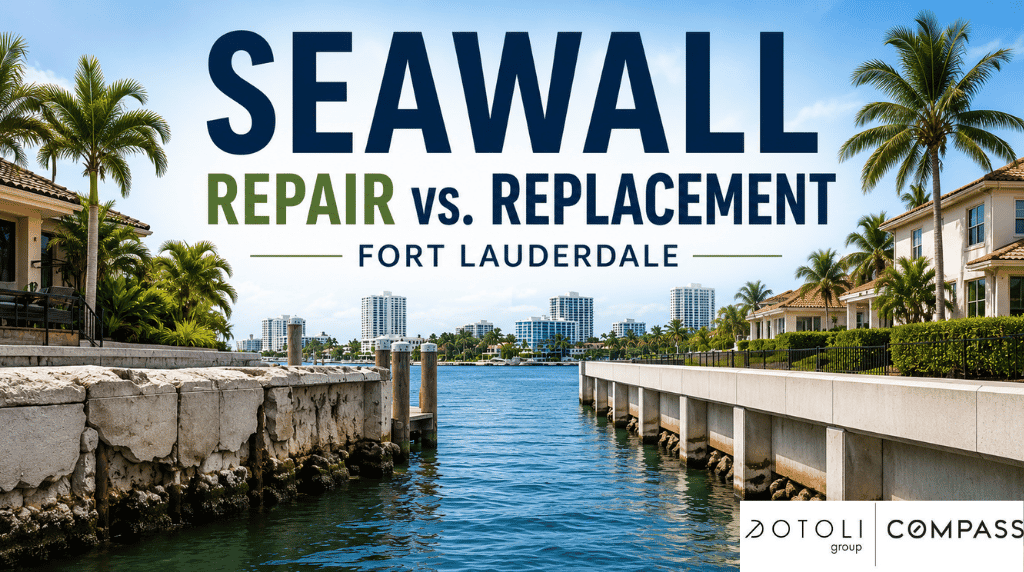

Seawall repair addresses isolated, localized damage on a structurally sound wall. Seawall replacement is required when the wall has failed structurally across a significant portion of its length, when tiebacks have failed, or when Fort Lauderdale’s tidal barrier ordinance triggers a mandatory rebuild.
Repair costs $500 to $1,000 per linear foot for affected sections. Replacement runs $1,500 to $2,500 or more per linear foot for the full run.
Knowing which path applies to your property is the difference between a $20,000 repair and a $200,000 replacement. If you are under contract on a Fort Lauderdale waterfront home and trying to interpret a seawall inspection report, or you own a waterfront property and just noticed something wrong, this guide gives you the decision framework before you call a contractor.
What Is the Actual Difference Between Seawall Repair and Seawall Replacement?
Repair and replacement are not just different in scale. They are different in what they address.
Seawall Repair
Repair targets specific, localized failure points while leaving the wall’s structural system intact. Typical repair work includes epoxy or polyurethane grout injection into hairline cracks, patching spalled concrete on the face or cap, treating exposed rebar to stop corrosion, and resetting a single panel that has shifted. At the same time, the rest of the wall holds alignment.
Repair is appropriate when the panels are sound, the tieback and anchor system is intact, and the damage is limited to a section that can be addressed without disturbing the rest of the wall.
Seawall Replacement
Replacement involves removing the existing wall entirely and installing a new one. This means extracting or abandoning existing panels, driving new precast concrete or vinyl sheet panels into the canal bottom, installing a new tieback and anchor system, and pouring a new reinforced cap.
Replacement is required when the structural integrity of the wall is compromised across a meaningful portion of its length, when the tieback system has failed, when soil has eroded behind the wall creating voids, or when Fort Lauderdale’s ordinance mandates a rebuild.
What Warning Signs Tell You Which Direction You Are Heading?
A seawall does not fail overnight. It gives warnings before it gives out. Knowing what to look for helps you catch a repair situation before it becomes a replacement.
Warning Signs That Suggest Repair Is Still an Option
Hairline cracks running vertically or diagonally across the concrete face are usually a repair situation if the panel has not moved and the wall holds its alignment. Minor spalling, meaning small chips or flaking on the concrete surface, is a cosmetic and maintenance issue that can typically be patched.
A crumbling or separated cap with no movement in the panels beneath it is a repair, specifically a cap replacement, not a full wall job.
These signs indicate the wall is aging but not structurally compromised. Catching them early and addressing them extends the wall’s life significantly.
Warning Signs That Suggest Replacement Is Coming
Horizontal cracking is a serious signal. A horizontal crack in a concrete seawall panel usually means the tieback anchor behind the wall has failed or the panel is bowing from hydrostatic pressure. This is not a patch situation.
Panel bow or lean is another red flag. If the wall face curves outward toward the water or leans visibly from vertical, the tieback system is likely compromised. Patching the surface does nothing for a wall that is moving.
Soil loss behind the wall is the most urgent warning sign. If you see sinkholes, depressions, or ground subsidence along the top of the seawall, soil has migrated through gaps in the panels into the canal. That means the panels have failed structurally, not just cosmetically, and the bank behind them is no longer supported.
Tidal water coming through the wall, specifically visible water flowing through gaps in the panels at high tide, is active failure. The wall is no longer performing its function.
Read our seawall inspection schedule guide for the full checklist of what a licensed inspector looks for and how to read an inspection report.
What Does Fort Lauderdale’s Ordinance Say About Repair vs. Replacement?
The City of Fort Lauderdale’s tidal barrier ordinance removes the choice in one specific scenario: when damage exceeds 50 percent of the seawall structure, the city requires a full replacement built to current standards, not a repair.
The 50 percent threshold and current height standard below are based on Fort Lauderdale’s tidal barrier ordinance as referenced in marine contractor guidance and city building department resources. Verify current requirements with the City of Fort Lauderdale Building Services before making permitting decisions.
The current minimum height standard for a replacement seawall is 5 feet NAVD (North American Vertical Datum of 1988). This is higher than the previous standard of 3.9 feet NAVD. If your existing wall was built to the older standard, a full replacement does not just rebuild what was there. It requires rebuilding taller, which adds material and labor costs.
This ordinance creates a critical boundary in the repair vs. replacement decision. A wall with 40 percent damage might be repairable under city rules.
A wall with 55 percent damage is not, regardless of what a contractor tells you. Understanding where your wall falls relative to that threshold is one of the first questions to ask any marine contractor you hire.
How Do You Know Which One Your Situation Actually Requires?
The answer to seawall repair vs. replacement in Fort Lauderdale for your specific property comes down to a clear set of criteria.
Repair Is the Right Path When:
- Damage is isolated to one or two sections of the wall
- The panels are structurally intact and holding alignment
- The tieback and anchor system is functional
- Damage represents less than 50 percent of the total structure
- The wall is under 25 years old and was properly built
- No soil loss or voids exist behind the panels
Replacement Is the Right Path When:
- Damage exceeds 50 percent of the wall structure (city ordinance mandates replacement)
- Horizontal cracking, bowing, or lean indicates tieback failure.
- Soil has eroded behind the wall creating voids or surface depressions.
- The wall is at or past its material lifespan (concrete seawalls in saltwater environments typically last 30 to 50 years depending on construction quality and maintenance)
- Tidal water is passing through panel gaps.
- A prior repair failed within a short timeframe, indicating systemic failure rather than isolated damage.
If your situation falls in the grey zone, meaning 30 to 50 percent damage with some intact sections and some compromised ones, get two independent assessments from licensed Fort Lauderdale marine contractors before committing to either path. The cost difference between the two paths is significant enough to justify the extra time.
See our full seawall replacement cost guide for a breakdown of what replacement costs by material and what drives the total project cost up or down.
What Happens If You Repair When You Actually Needed Replacement?
This is the outcome most homeowners and buyers are trying to avoid, and it is more common than it should be.
The Repair Fails Faster Than Expected
A repair that addresses surface symptoms on a structurally compromised wall does not fix the underlying problem. If the tieback has failed, patching the panel face does nothing. The wall continues to move, and the repair materials fail within months rather than years.
You Spend Money Twice
A failed repair on a wall that needed replacement means paying for the repair, then paying for the full replacement anyway. The repair cost is not recovered. The total cost ends up higher than if you had gone straight to replacement.
Permitting Issues at Resale
A repaired wall that was required to be replaced under Fort Lauderdale’s ordinance creates a permitting problem. If city records indicate the wall was past the 50 percent damage threshold and only a repair permit was pulled, that discrepancy can surface at the next sale inspection or during a future permit application.
Liability for Neighboring Property
A Fort Lauderdale seawall that fails and allows tidal water or eroded soil to affect a neighboring property or the canal creates liability. A repair that delays but does not prevent that failure does not transfer the liability.
Properties on finger canals, where the seawall sits close to neighboring lots with limited barge access for later replacement work, face compounded risk if a failing wall is patched rather than replaced.
Read our finger canal guide to understand how canal type affects both seawall risk and the logistics of any future replacement.
What Permits Does Each Path Require in Fort Lauderdale?
Permits for Seawall Repair
Minor seawall repairs in Fort Lauderdale typically require a building permit from the City of Fort Lauderdale Building Services Division.
Depending on the scope, a Florida Department of Environmental Protection permit may also be required, particularly if the repair involves work below the mean high water line. Smaller cosmetic repairs such as cap patching may qualify for simplified permitting.
Permits for Seawall Replacement
Full replacement requires permits from the City of Fort Lauderdale Building Services, the Florida Department of Environmental Protection, and in most cases the Army Corps of Engineers. Engineering drawings from a licensed engineer are required.
The permitting process for replacement typically adds 60 to 90 days to the project timeline before construction can begin.
Permitting cost and timeline are one practical reason some property owners push toward repair when replacement is the right answer. Understanding the true cost of that decision is important before making it.
Frequently Asked Questions
What is the difference between seawall repair and seawall replacement?
Repair targets isolated damage on a structurally sound wall. Replacement removes the entire structure and installs a new one. The decision turns on how much of the wall is compromised and whether the tieback system is still functional.
How much does seawall repair cost in Fort Lauderdale?
Seawall repair in Fort Lauderdale typically costs $500 to $1,000 per linear foot for the damaged sections. Total cost depends on how many linear feet require work and the nature of the damage.
When does Fort Lauderdale require full seawall replacement instead of repair?
The city’s tidal barrier ordinance requires full replacement when damage exceeds 50 percent of the wall structure. Replacement must also meet the current minimum height standard of 5 feet NAVD, which is higher than the previous 3.9 feet NAVD standard.
Can I repair a seawall that is leaning or bowing toward the water?
Lean or bow usually indicates tieback failure, which is a systemic structural problem, not a surface issue. Patching the panel face does not address a failed tieback. Most bowing or leaning walls require replacement, not repair.
How long does a seawall repair last in Fort Lauderdale?
A properly executed repair on a structurally sound wall can last 10 to 20 years or more. A repair applied to a wall with underlying structural problems typically fails within months to a few years. The quality and root cause of the repair determine longevity, not the repair technique alone.
Does a seawall repair or replacement require permits in Fort Lauderdale?
Both require permits. Repair permits are simpler and faster to obtain. Full replacement requires permits from the City of Fort Lauderdale, Florida DEP, and usually the Army Corps of Engineers, adding 60 to 90 days to the timeline before construction begins.
Talk to Dotoli Group Before You Make the Call
If you are under contract on a Fort Lauderdale waterfront home and trying to figure out whether a seawall inspection report means repair or replacement, get a contractor quote before your inspection contingency expires. The report tells you something is wrong. The quote tells you what it costs and which path the wall actually requires.
Dotoli Group has navigated seawall negotiations across Fort Lauderdale’s canal neighborhoods at every price point.
If you need help understanding how a seawall issue affects your deal, contact us before your contingency period closes. And if you are still searching for the right waterfront property, our waterfront buying guide covers every due diligence step before you make an offer.