
If you are buying a Fort Lauderdale waterfront home or planning a dock upgrade, the choice between a boat lift and a fixed dock is one of the first decisions that affects how you use the property every day. The right answer depends on your vessel, your canal, and how you boat.
Boat Lift vs. Fixed Dock
A boat lift vs fixed dock Fort Lauderdale decision comes down to vessel size and saltwater exposure. A boat lift keeps your hull out of the water, dramatically slowing corrosion and marine growth. It is ideal for boats under 80,000 pounds on narrower canals. A fixed dock suits larger or multiple vessels and deepwater canals where lift installation is impractical.
What Is a Boat Lift and How Does It Work?
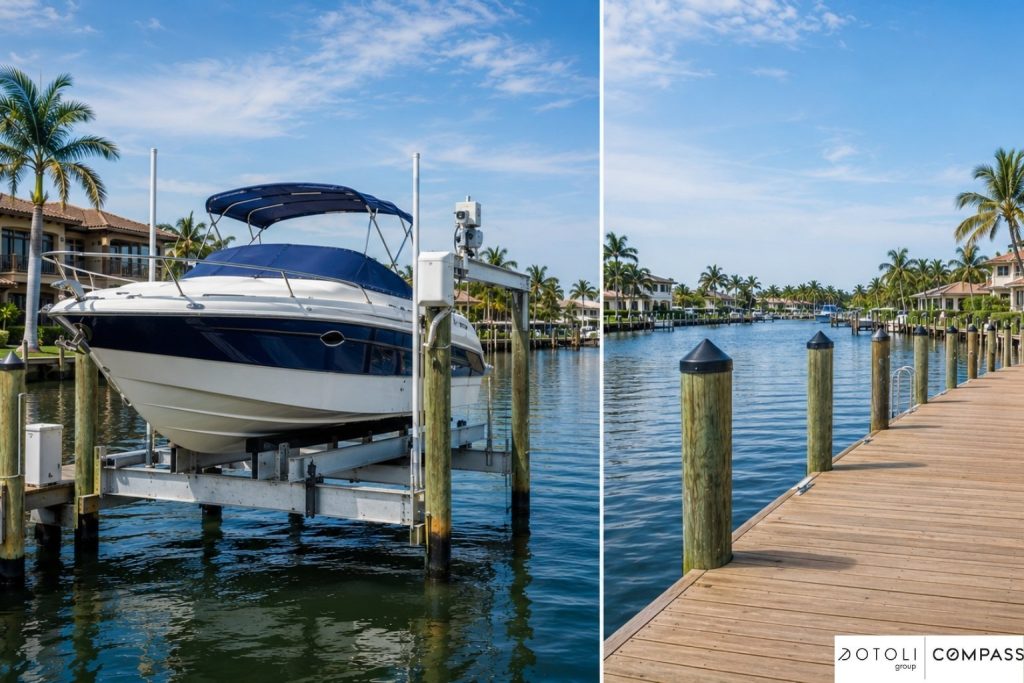
A boat lift is a mechanical system that raises your vessel out of the water when it is not in use. Most residential boat lifts in Fort Lauderdale use either a four-post cradle system or a floating drive-on platform. Electric motors driven by cables or hydraulics lift the boat above the waterline, where it sits suspended until the next use.
The core benefit is simple: a boat that is not sitting in saltwater is not accumulating marine growth on the hull, is not experiencing constant waterline corrosion on metal fittings, and is not subject to electrolytic corrosion from stray current in the canal.
According to BoatUS Foundation, keeping a boat out of the water when not in use is one of the most effective ways to extend hull life and reduce maintenance costs over time.
Boat lifts in Fort Lauderdale typically accommodate vessels ranging from small center consoles up to boats in the 30,000 to 80,000-pound range, depending on the lift system. Four-post lifts are the most common residential installation. Larger elevator-style lifts can handle heavier vessels but require more canal depth and engineering.
What Is a Fixed Dock and How Does It Work?
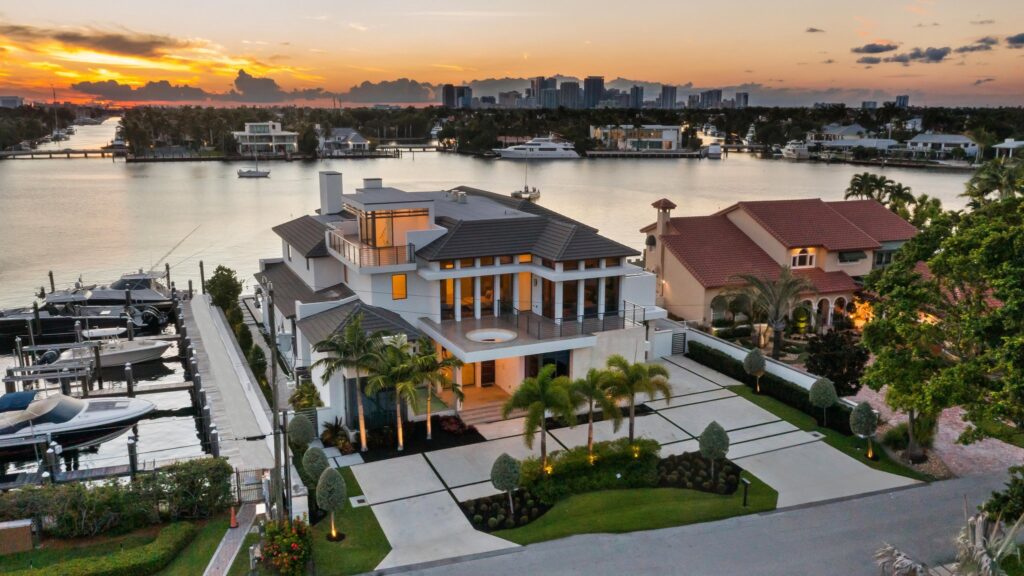
A fixed dock is a stationary platform built over the water and anchored to pilings driven into the canal bottom. It provides a stable surface for boarding, storage, and line handling regardless of tidal variation. The vessel ties alongside or at the end of the dock and floats in the water at all times.
Fixed docks in Fort Lauderdale are typically constructed from pressure-treated wood, composite decking, or concrete on aluminum or steel pilings. They range from simple single-finger piers to full wraparound dock systems with shore power pedestals, water hookups, and davit arms for small tenders.
A fixed dock offers more flexibility for multiple vessels, larger boats that exceed lift weight limits, and properties where the canal depth or width makes lift installation impractical. It is also the standard dock configuration for properties that accommodate sportfish boats, center consoles in the 35-foot-and-up range, and motoryachts.
How Much Does Each Option Cost in Fort Lauderdale?
Cost is often the first question, and the ranges for both options vary significantly based on size, materials, and site conditions.
Boat Lift Cost in Fort Lauderdale
Cost figures below are based on commonly cited South Florida marine contractor estimates and vary by lift capacity, brand, and installation complexity. Get current quotes from a licensed Florida marine contractor before budgeting.
A residential four-post boat lift in Fort Lauderdale typically costs $8,000 to $20,000 installed for lifts in the 10,000 to 20,000 pound capacity range.
Larger capacity lifts handling boats in the 30,000 to 80,000 pound range run $20,000 to $50,000 or more. Installation on a finger canal with limited barge access adds cost regardless of lift size.
Fixed Dock Cost in Fort Lauderdale
A standard residential fixed dock in Fort Lauderdale runs $15,000 to $50,000 installed, depending on linear footage, material choice, and required piling depth.
Composite decking costs more than pressure-treated wood upfront but holds up significantly better in Fort Lauderdale’s saltwater environment over a 10- to 20-year horizon.
A full dock system with shore power, water, and davit arms for a tender can run $75,000 or more on a larger property.
How Does Saltwater Corrosion Affect Each Option?
Saltwater corrosion is the single largest ongoing cost driver for any marine structure in Fort Lauderdale’s canal system, and the two dock options respond to it very differently.
A boat lift reduces corrosion on the vessel itself by keeping the hull out of the water. But the lift hardware, including the cables, motor, cradle bunks, and frame, sits in a saltwater environment and corrodes continuously.
Lift cables require inspection and replacement on a regular schedule. Motors need protective housing and freshwater flushing after salt exposure. Aluminum frames hold up better than steel, but no lift hardware is immune.
A fixed dock concentrates corrosion on the pilings and framing rather than the vessel. Steel pilings in Fort Lauderdale’s saltwater canals require marine-grade coatings or cathodic protection systems to extend their lifespan. Composite decking avoids the rot and corrosion issues of wood but does not eliminate piling and hardware concerns.
Our article on saltwater corrosion and Fort Lauderdale waterfront homes covers how salt air and saltwater attack every system on a canal property, not just the dock, and what ongoing maintenance actually looks like.
Does Canal Type Determine Which Option Is Viable?
Canal type is often the deciding factor in Fort Lauderdale, particularly for properties on narrower waterways.
Finger Canals
Finger canals, the narrower residential waterways that branch off Fort Lauderdale’s main canal network, typically range from 40 to 80 feet wide.
A boat lift installation on a finger canal is usually viable for most residential vessels, but the narrow water width limits barge access for installation and can restrict the turning radius needed to drive a larger boat onto a drive-on lift platform.
Properties on finger canals also tend to have shallower water depths, which constrains the vessel size that a fixed dock can realistically accommodate.
Read our finger canal guide for a full breakdown of how canal width affects property use, dock options, and what to evaluate before buying.
Deepwater Canals
Wider, deepwater canals give you more options. A deepwater canal with 8 to 12 feet of depth at the dock can accommodate both lift systems and fixed docks for larger vessels. Properties on deepwater canals attract buyers with larger boats precisely because both dock configurations are viable.
How Does Vessel Size Determine the Right Choice?
Vessel size and weight create a clear decision boundary in most cases. If your primary vessel is a center console, flats boat, or any boat under approximately 30 feet, a boat lift is almost always the better choice in Fort Lauderdale’s saltwater environment.
Keeping a smaller boat out of the water when not in use reduces hull maintenance costs significantly over the life of ownership.
If your primary vessel is a sportfish or motoryacht in the 40-foot-and-up range, a fixed dock becomes the practical solution. Lifts capable of handling boats in this weight class are expensive, require significant canal depth, and are not viable on most residential finger canals.
A fixed dock with proper fender systems and shore power is the standard configuration for larger vessel owners.
If you have two vessels of different sizes, a combination setup with a fixed dock for the larger boat and a lift or davit for the smaller tender or flats boat is common on Fort Lauderdale canal properties with sufficient frontage.
What Permits Does Each Option Require in Fort Lauderdale?
Permitting requirements below reflect general guidance from Fort Lauderdale Building Services and Florida DEP. Requirements change and vary by property. Verify current permit requirements with the City of Fort Lauderdale and a licensed marine contractor before beginning any dock project.
Both boat lifts and fixed docks require permits in Fort Lauderdale. A boat lift installation typically requires a building permit from the City of Fort Lauderdale and a Florida Department of Environmental Protection permit for work over navigable waters. The DEP review can add 30 to 60 days to the project timeline.
A fixed dock requires the same permit types, and larger dock projects or those in environmentally sensitive areas may also require Army Corps of Engineers review.
Projects that extend the dock beyond the existing footprint or add square footage trigger a more thorough review than lift replacements on an existing dock structure.
Understanding the permit status of an existing dock is an important due diligence step when buying a Fort Lauderdale waterfront home. An unpermitted dock or lift creates a problem at resale.
Our waterfront buying guide covers how to verify dock permit status and what other marine structure questions to ask before closing.
Does a Boat Lift or Fixed Dock Add More Value at Resale?
Both a functional boat lift and a well-maintained fixed dock add value to a Fort Lauderdale waterfront property. The question is which one the buyer pool for your property type will prioritize.
Resale value impact figures are not uniformly established. The following reflects general market observation in Fort Lauderdale’s canal real estate market.
A property with a well-maintained four-post lift in good working condition adds immediate practical value for buyers who boat regularly and want to protect their vessel from saltwater.
A property with a deepwater fixed dock that can accommodate a 50-foot motoryacht attracts a different and often higher-net-worth buyer who already owns a larger vessel.
The worst outcome at resale is a dock or lift in disrepair. A deteriorating fixed dock with rotting decking, failing pilings, and unpermitted additions is a liability that reduces offer prices and gives buyers renegotiation leverage. A boat lift with failing cables, a corroded motor, and nonfunctional controls is no better.
Keeping the dock or lift in documented, permitted, functional condition is one of the highest-return maintenance investments on a Fort Lauderdale waterfront property. The same applies to the seawall beneath it. If the dock is solid but the seawall is deteriorating, the problem is still there.
Review our seawall inspection schedule to understand how often the wall under and around your dock structure should be assessed.
Which Option Is Right for You? A Decision Framework
-
- Your primary vessel is under approximately 30 feet and within standard residential lift weight limits
- You boat frequently and want to minimize hull maintenance and marine growth
- Your canal depth and width support lift installation
- You want lower long-term vessel maintenance costs over a 5 to 10 year horizon
- If your primary vessel exceeds residential lift weight or size limits
- You have a deepwater canal with sufficient depth for your vessel at all tide stages
- You operate multiple vessels or need flexible berthing options
- Your canal width or water depth makes lift installation impractical
- You have adequate canal frontage and own vessels of different sizes
- You want lift protection for a smaller boat and a fixed berth for a larger one
Understanding what the seawall beneath your dock can actually support is part of this decision. A dock or lift installed on a deteriorating seawall is a compounding liability. See our seawall replacement cost guide if the wall condition is a question mark on the property you are evaluating.
FAQ’s
What is the difference between a boat lift and a fixed dock in Fort Lauderdale?
A boat lift raises your vessel out of the water when not in use, reducing hull corrosion and marine growth. A fixed dock keeps the vessel in the water alongside a stationary platform. Lifts suit smaller boats; fixed docks suit larger vessels and multiple-boat households.
How much does a boat lift cost in Fort Lauderdale?
Residential boat lifts in Fort Lauderdale run $8,000 to $20,000 installed for standard capacity lifts and $20,000 to $50,000 or more for larger systems. Cost varies by lift capacity, canal access, and whether the installation requires barge mobilization.
Do boat lifts and fixed docks require permits in Fort Lauderdale?
Yes. Both require a City of Fort Lauderdale building permit and a Florida DEP permit for work over navigable waters. Larger dock projects may also require Army Corps of Engineers review, adding 30 to 90 days to the permitting timeline.
Which is better for saltwater protection, a boat lift or a fixed dock?
A boat lift is better for protecting the vessel from saltwater exposure. Keeping the hull out of the water eliminates constant waterline corrosion and marine growth. A fixed dock protects nothing about the boat itself but offers more flexibility for larger vessels.
Can I install a boat lift on a finger canal in Fort Lauderdale?
Usually yes, for standard residential vessels. Finger canal width can limit barge access for installation and constrain the turning radius for drive-on lift platforms. Water depth is also a factor. A licensed marine contractor should assess the specific canal before you commit.
Does a boat lift or fixed dock add more value to a Fort Lauderdale waterfront home?
Both add value when maintained and permitted. A functional lift appeals to buyers with smaller vessels who prioritize hull protection. A deepwater fixed dock appeals to buyers with larger boats.
A deteriorating or unpermitted structure in either case reduces offer prices and creates renegotiation leverage.
Buying a Waterfront Home Fort Lauderdale?
The dock situation on a waterfront property tells you more about how it has been maintained than almost anything else.
Dotoli Group knows which properties have the canal depth, frontage, and seawall condition to support the dock configuration you need.
Contact Dotoli Group before you make an offer on any Fort Lauderdale canal property.