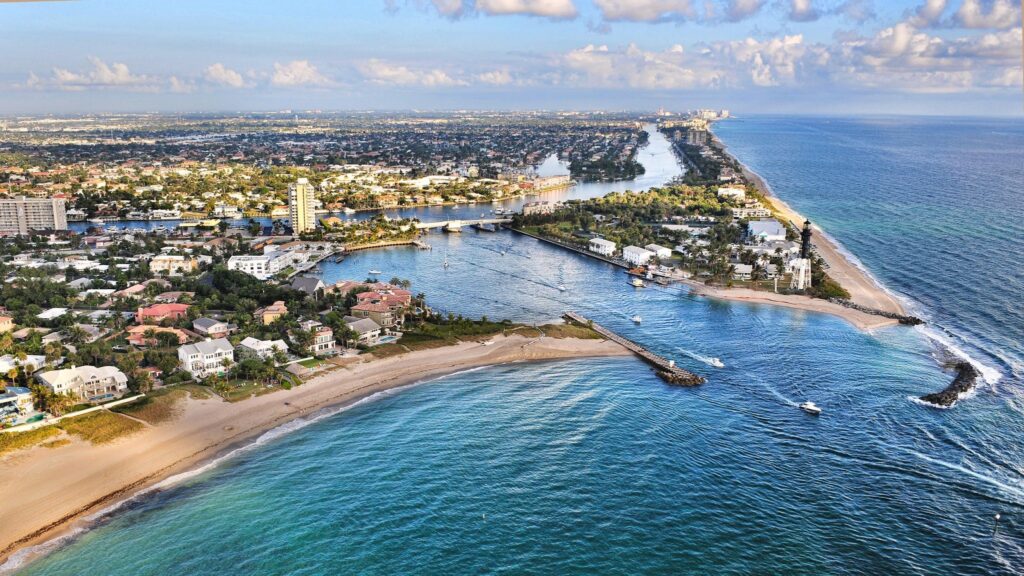
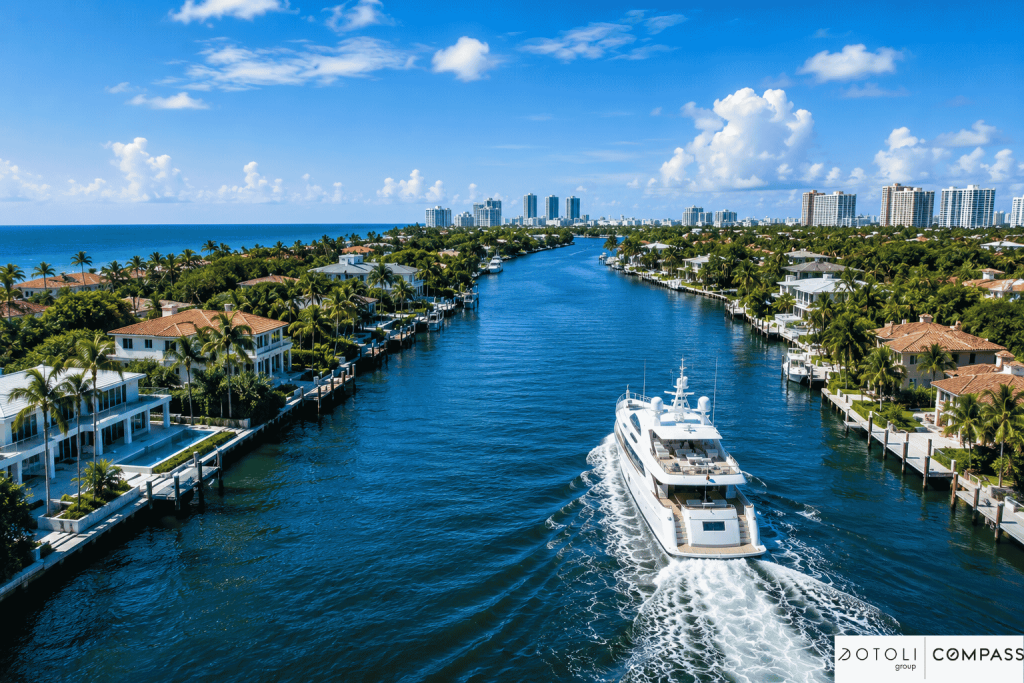

If you own a boat with a tall flybridge, a sportfish tower, or a sailboat mast, the bridge situation between your dock and the ocean is not a minor detail. It determines whether you can actually use your vessel from that property at all.
What Is a No-Fixed-Bridge Waterway?
A no-fixed-bridge waterway in Fort Lauderdale is a canal or waterway that connects directly to the ocean or Intracoastal without passing under any bridge with a permanently fixed vertical clearance.
Every waterway between your dock and open water is either open, spanned by a drawbridge that raises on demand, or served by an inlet with no overhead obstruction. Your vessel travels out without any height restriction.
What Is a Fixed Bridge and Why Does Clearance Height Matter?
A fixed bridge is a bridge with a stationary deck at a set height above mean high water. It does not open, raise, or accommodate vessels taller than its fixed vertical clearance. Whatever height is posted on that bridge is the hard ceiling for every vessel that wants to pass beneath it.
The 17th Street Causeway as a Real Example
Fort Lauderdale’s 17th Street Causeway bridge has a fixed vertical clearance of approximately 55 feet above mean high water. That sounds generous until you factor in what it actually blocks. A sportfish boat with a tall tower, a motoryacht with a radar arch and hardtop, or a sailing vessel with a mast above 55 feet cannot pass under it.
That bridge sits between Port Everglades and the properties to its north and west, creating a permanent vessel size restriction for any property on the wrong side of it.
Other fixed bridges in the Fort Lauderdale waterway system have significantly lower clearances. Some residential canal bridges clear as little as 20 to 25 feet, which blocks even moderately sized power vessels with a T-top or tuna tower.
How Bridges Are Classified
Bridges over navigable waterways are classified by the U.S. Army Corps of Engineers and the U.S. Coast Guard, which maintain bridge vertical clearance data for every federally maintained waterway.
Fixed bridges carry a posted clearance that reflects the lowest point of the bridge deck above mean high water, typically at the center of the span. That number is the hard limit for any vessel transiting that waterway.
According to NOAA’s Office of Coast Survey, vertical clearance data for bridges over navigable waters is published on official nautical charts and is updated when bridge structures change.
Before purchasing any waterfront property, verifying the bridge clearances on the route between the dock and the ocean on a current NOAA nautical chart is a basic step that many buyers skip.
What Is the Difference Between a No-Fixed-Bridge Waterway and a Drawbridge Waterway?
This distinction catches many buyers off guard, and confusing the two can lead to a costly mistake.
What a Drawbridge Actually Means
A drawbridge, technically called a bascule bridge in most of Fort Lauderdale’s waterway system, is a bridge with a movable span that raises vertically to allow taller vessels to pass.
When the bridge is raised, it has no effective height restriction. When it is in the closed position, it has the same restriction as a fixed bridge of equivalent deck height.
The critical difference from a boating perspective is that a drawbridge gives you access on demand, typically by radio request on VHF channel 9, provided you are within the bridge’s operating hours and schedule.
Most drawbridges on Fort Lauderdale’s waterways operate on a schedule with set opening times. Some open on request; others open on the hour and half-hour; and some have restricted hours during peak traffic periods.
Why a Drawbridge Is Not the Same as No Fixed Bridge
A no-fixed-bridge waterway requires no bridge openings. You leave your dock and reach the ocean without waiting, scheduling, or coordinating with a bridge tender.
For live-aboard boaters, frequent cruisers, or anyone who uses their vessel at irregular hours, a no-fixed-bridge route is materially different from a route with even one drawbridge.
A drawbridge also introduces points of failure. Bridge malfunctions, maintenance closures, and operator schedules can strand a vessel on the wrong side of the bridge for hours. On a no-fixed-bridge waterway, that scenario does not exist.
Which Fort Lauderdale Neighborhoods Offer No-Fixed-Bridge Ocean Access?
Not every waterfront neighborhood in Fort Lauderdale qualifies. The no-fixed-bridge designation applies to specific waterways based on the routing between the property and the ocean, typically via Port Everglades Inlet or the Hillsboro Inlet to the north.
Las Olas Isles
Las Olas Isles is one of Fort Lauderdale’s most prominent no-fixed-bridge neighborhoods. Properties on the main canal arteries in Las Olas Isles have direct access to the Intracoastal Waterway and Port Everglades without transiting a fixed bridge.
This is one reason Las Olas Isles commands some of the highest waterfront property values in Fort Lauderdale.
Harbor Beach and Port Everglades Area
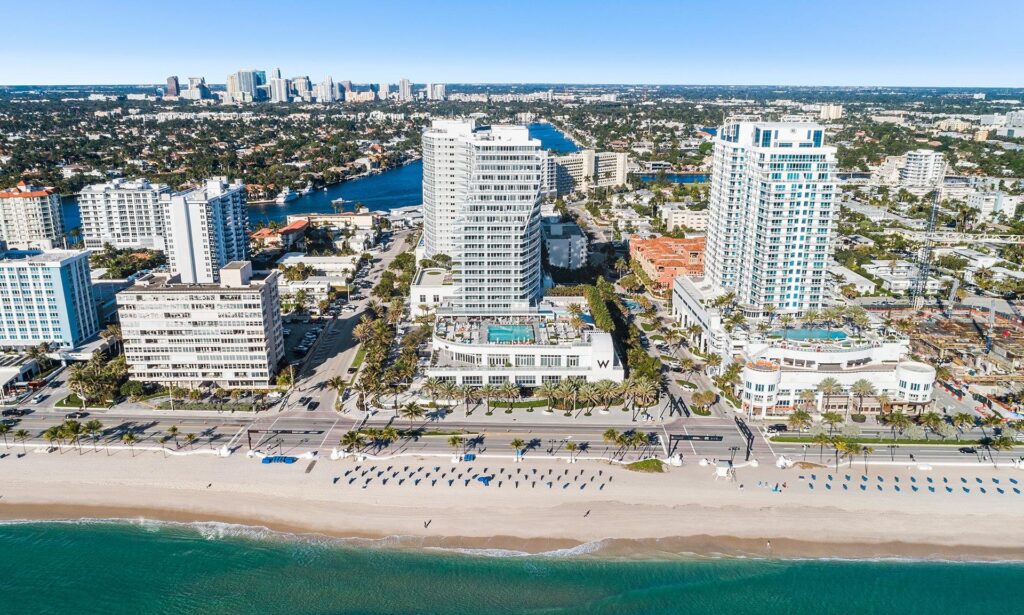
Properties in the Harbor Beach neighborhood and those directly accessible via Port Everglades inlet offer no-fixed-bridge access for vessels departing southward toward the inlet.
The Port Everglades inlet is Fort Lauderdale’s primary deepwater ocean access point and carries no fixed bridge crossing on the primary route.
New River and Tarpon River Considerations
Properties on the New River and Tarpon River systems face a more complex bridge picture. While some sections of these waterways offer drawbridge-only routes to the ocean, others do not have a completely fixed-bridge-free path, depending on the specific property location and which direction the vessel departs.
Buyers on these waterways should verify the specific routing for their dock before assuming no-fixed-bridge status.
Our Fort Lauderdale neighborhoods guide covers the waterway characteristics of each major neighborhood, including canal type, typical water depth, and bridge situation, so you can narrow your search before viewing properties.
Why Do No-Fixed-Bridge Properties Cost More in Fort Lauderdale?
The price premium for no-fixed-bridge waterfront homes in Fort Lauderdale is real and consistent. It reflects the fundamental difference in utility the property provides to a boater.
The following market observations reflect general pricing patterns in Fort Lauderdale’s waterfront real estate market.
Exact premium percentages vary by neighborhood, property condition, water depth, and current market conditions. Consult current MLS data and a Fort Lauderdale waterfront specialist for property-specific figures.
A no-fixed-bridge waterfront home in Fort Lauderdale typically commands a premium of 10 to 25 percent or more over a comparable property on the same canal type with a fixed bridge restriction on the route to the ocean.
On a $3 million waterfront home, that premium represents an additional $300,000 to $750,000 in purchase price.
Buyers are paying not just for the view but for the permanent, unrestricted ability to use whatever vessel they own from that dock.
What Do You Give Up When You Buy Behind a Fixed Bridge?
Buying a waterfront home behind a fixed bridge is not automatically a bad decision. But the trade-offs are permanent and deserve honest evaluation before you close.
Permanent Vessel Size Restriction
Whatever the lowest fixed bridge clearance is on your route to the ocean, that is your vessel size ceiling for the life of your ownership. You cannot negotiate with a bridge.
If you buy a property behind a 25-foot fixed bridge and then purchase a sportfish with a 32-foot tower, that boat cannot leave your dock toward the ocean. The restriction follows the property, not the buyer.
Narrower Resale Market
When you go to sell, your buyer pool excludes everyone who owns or plans to own a vessel that exceeds the bridge clearance.
In Fort Lauderdale’s boater-heavy luxury market, that exclusion is significant. A no-fixed-bridge property sells to a broader audience and typically sells faster.
Dependency on Drawbridge Schedules
If your route to the ocean includes a drawbridge, your departure times depend on that bridge’s operating schedule.
Early-morning departures for offshore fishing, late-night returns from a cruise, and spontaneous day trips all require alignment with bridge opening times. Over years of ownership, that constraint changes how you use the vessel.
Read our full waterfront buying guide for the complete due diligence checklist, including how to evaluate waterway access, canal depth, seawall condition, and dock configuration before making an offer.
How Do You Verify a Property’s Bridge Situation Before Making an Offer?
Do not rely on the listing description. “Boating access” and “no fixed bridge” are not interchangeable terms, and listing descriptions are written to sell the property, not to provide precise marine navigation data.
Check the NOAA Nautical Chart
Pull the current NOAA nautical chart for Fort Lauderdale’s Intracoastal Waterway and trace the route from the property’s dock position to the nearest ocean inlet.
Every bridge on that route will be labeled with its type (fixed or bascule) and its vertical clearance in feet. This takes 10 minutes and gives you factual data before you spend money on inspections.
Ask the Agent the Right Question
The question is not “does this property have boating access?” The question is “what is the complete routing from this dock to the ocean, and are there any fixed bridges on that route, and if so, what is the lowest clearance?”
An agent who cannot answer that question specifically does not specialize in Fort Lauderdale waterfront transactions.
Consider Canal Depth Alongside Bridge Clearance
Bridge clearance is the vertical constraint. Canal depth is the horizontal one. A no-fixed-bridge property on a shallow finger canal may have perfect air clearance but insufficient water depth for your vessel’s draft.
Read our deepwater canal guide to understand how water depth affects which vessels can practically use a waterfront property, and our finger canal guide for the tradeoffs on narrower waterways.
Which Vessel Types Need a No-Fixed-Bridge Waterway?
Not every boater needs no-fixed-bridge access. Here is the decision framework
You Need No-Fixed-Bridge Access If:
- You own a sailing vessel with a mast above 25 to 30 feet.
- You own a sportfish boat with a tower 25 to 30 feet above the water.
- You own a motor yacht with a flybridge, hardtop, or radar arch above 25 to 30 feet.
- You plan to upgrade to a larger vessel in the next 5 to 10 years and want the property to accommodate future growth.
- You boat at irregular hours frequently and do not want to be dependent on the drawbridge schedule.
A Fixed-Bridge Property May Work If:
- Your primary vessel is a center console, bowrider, or other low-profile powerboat that clears the lowest bridge on the route.
- You boat recreationally on the Intracoastal and rarely need ocean access.
- The property offers significant value advantages over no-fixed-bridge alternatives, and your vessel fits comfortably within the clearance.
If you are also deciding between dock configurations on either type of waterway, our boat lift vs. fixed dock guide covers how canal type and vessel size should shape that decision as well.
Frequently Asked Questions
What is a no-fixed-bridge waterway in Fort Lauderdale?
A no-fixed-bridge waterway connects your dock to the ocean without passing under any bridge with a permanent fixed clearance. Every crossing on the route is either open water, a drawbridge that raises on demand, or an inlet with no overhead obstruction.
Why do no-fixed-bridge waterfront homes cost more in Fort Lauderdale?
No-fixed-bridge properties command a 10 to 25 percent premium over comparable fixed-bridge properties. Buyers pay for unrestricted vessel access, a larger resale pool, and the ability to use any-size vessel from that dock without height limitations.
Which Fort Lauderdale neighborhoods have no-fixed-bridge ocean access?
Las Olas Isles and Harbor Beach are the most established no-fixed-bridge neighborhoods in Fort Lauderdale. Port Everglades inlet serves as the primary no-bridge ocean access route. Verify the specific routing for any property before purchasing, as access varies by dock location within a neighborhood.
Is a drawbridge the same as no fixed bridge?
No. A drawbridge raises on demand but operates on a schedule and can malfunction or close for maintenance. A no-fixed-bridge waterway requires zero bridge openings. The difference is unrestricted departure at any time versus coordinating with a bridge schedule.
What vessel types require a no-fixed-bridge waterway in Fort Lauderdale?
Sailboats with masts above 25 to 30 feet, sportfish vessels with tall towers, and motor yachts with high flybridges or radar arches typically require no-fixed-bridge access. Low-profile powerboats and center consoles often clear fixed bridges on standard residential waterways.
How do I verify a property’s bridge situation before making an offer?
Check the current NOAA nautical chart for Fort Lauderdale’s Intracoastal Waterway and trace the full route from the dock to the nearest inlet. Every bridge will be labeled with type and vertical clearance. Do not rely on listing descriptions alone.
Work with an Agent Who Knows the Waterways, Not Just the Listings
Most real estate agents can tell you a Fort Lauderdale waterfront home has “boating access.” Dotoli Group can tell you the exact bridge clearances along the route from that dock to the ocean, the water depth at mean low tide, and whether the property is suitable for your specific vessel.
Contact Dotoli Group before you make an offer on any Fort Lauderdale waterfront property.