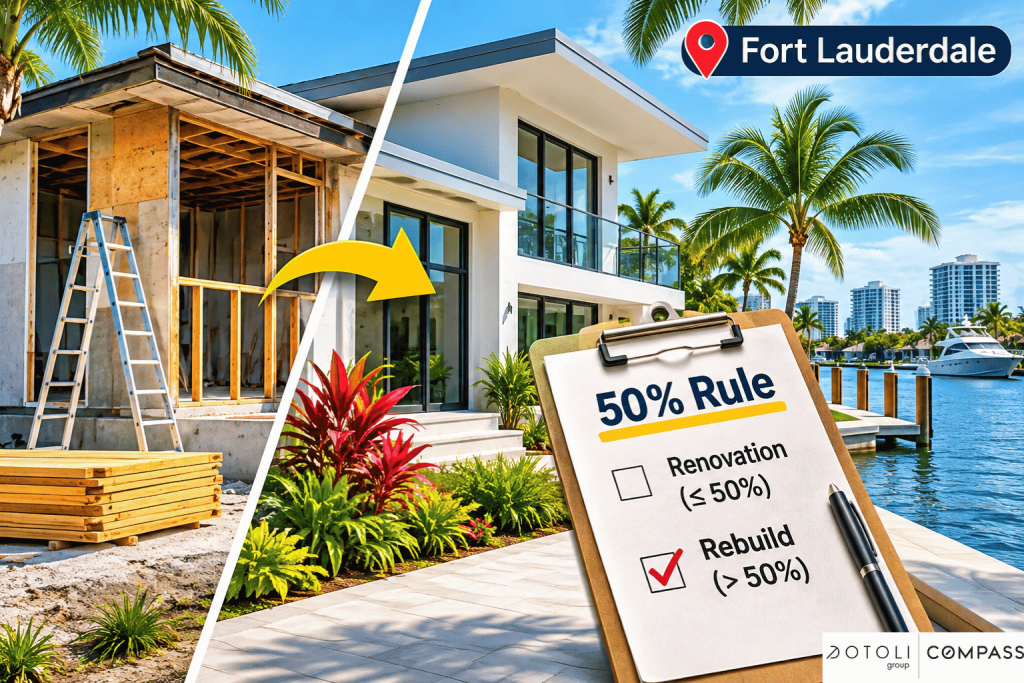

In a Fort Lauderdale flood zone, if the cost of renovating a house equals or exceeds 50 percent of the building’s market value, not counting the land, the City treats it as a substantial improvement. The whole house then has to meet today’s flood rules for new construction, which usually means raising the lowest floor. On many older waterfront homes, that turns a renovation plan into a rebuild.
What is the 50% rule?
It is the National Flood Insurance Program’s substantial improvement rule, which every participating city enforces, including Fort Lauderdale. If the cost of an improvement equals or exceeds 50 percent of the building’s market value before the work starts, the building must be brought up to the flood rules for new construction.
The same test applies after damage: if restoring a home to its pre-damage condition would cost 50 percent or more of its pre-damage market value, it is substantially damaged and the same requirement applies.
Two details matter. The value is the building’s value only, without the land. And the City’s building official makes the determination, not FEMA, your lender or your contractor.
Why does the rule hit older waterfront homes so hard?
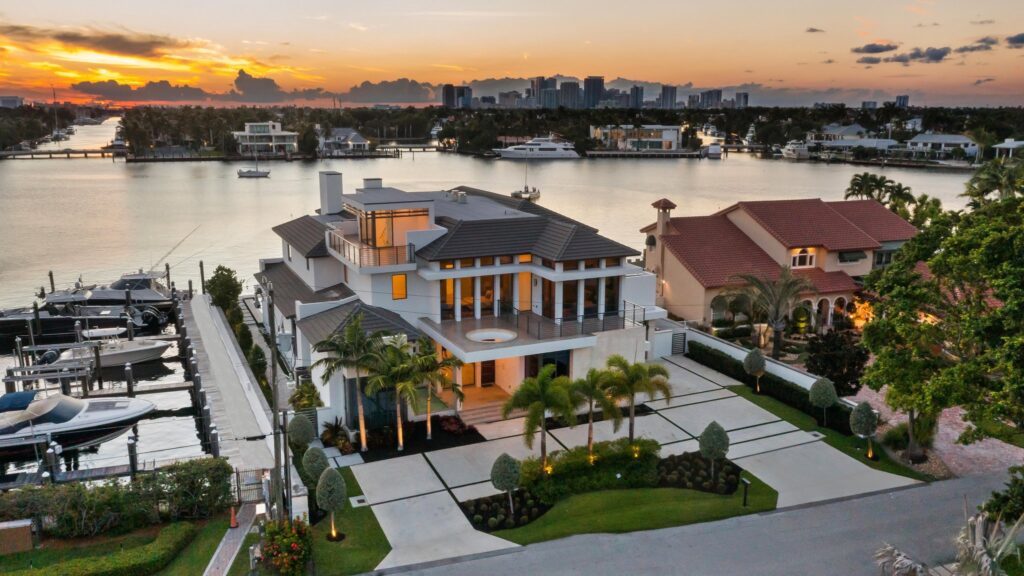
Because the building is often a small part of what the property is worth. On a waterfront lot in neighborhoods like Las Olas Isles, most of the price is the land and the water. The house itself, especially one built decades ago, can carry a modest market value. Half of a modest number is a renovation budget that a new kitchen, new baths, a new roof and new windows can pass quickly.
Many of those older houses also sit below today’s required flood elevation. Once the rule applies, the choice is usually between lifting the existing house, which can be hard on an older slab-on-grade home, and tearing it down to build new at the right height. That path is covered in our guide to buying a teardown in Fort Lauderdale.
What counts toward the 50%?
Under FEMA’s substantial improvement guidance, FEMA P-758, the count includes the construction work on the building itself: structural work, interior finishes, kitchens and baths, built-in equipment, electrical and plumbing, roofing, and the contractor’s overhead and profit, even on work you do yourself at its market cost.
It generally leaves out plans and specifications, surveys, permit fees, landscaping, pools, fences and detached structures.
The City applies its own worksheet to each permit, so ask early which items it will count on your plans, and get the contractor’s estimate itemized in the same way.
How is the market value of the house set?
The building’s market value is the starting number, and it decides how much you can spend before the rule applies.
Ask the City’s floodplain staff which value it will accept for the house you are buying, such as a figure based on the Broward County Property Appraiser’s building value or a professional appraisal of the structure alone.
A well-supported appraisal can matter, because a higher building value leaves more room for a renovation that stays under the line.
What did SB 180 change in 2025?
It removed look-back periods. The City of Fort Lauderdale’s substantial improvement worksheet, revised in February 2024, added up improvements over a two-year window, so work done by a previous owner could count against yours. Florida’s Senate Bill 180, signed on June 26, 2025, prohibits communities in the National Flood Insurance Program from using these cumulative look-back periods, according to the Florida Senate’s bill summary.
In practice, that should mean each permit is measured on its own. Confirm with the City how it applies the rule today before you plan a renovation in phases, and keep the permit history for the house, which our Fort Lauderdale permit search guide shows how to pull.
How high does the house need to be?
A new or substantially improved home in an AE flood zone must have its lowest floor at or above the base flood elevation on the FEMA map, plus at least 1 foot under the Florida Building Code, and the City can require more.
Broward County’s current FEMA flood maps took effect on July 31, 2024, so check the address on the new maps. The elevation certificate on the existing house shows how far below that line it sits. Each zone is explained in our guide to flood zones in Fort Lauderdale.
Is there a separate 50% rule for the seawall?
Yes, and buyers often miss it. Under Fort Lauderdale Ordinance C-23-05, adopted on March 23, 2023, new seawalls, and seawalls repaired past the 50 percent substantial repair threshold, must meet the City’s minimum top elevation, which steps up to 5 feet NAVD88.
A house renovation and a seawall repair are measured separately, so check both. Our seawall inspection guide explains what an inspector looks for.
Does insurance help if a storm triggers the rule?
Sometimes. If a flood damages the house and the City declares it substantially damaged by flood, an NFIP flood policy’s Increased Cost of Compliance coverage pays up to $30,000 toward elevating, floodproofing, relocating or demolishing it, according to FEMA. It does not apply to a renovation you choose to do. Our guide to waterfront home insurance in Fort Lauderdale covers the policies.
What should you check before you buy an older waterfront home?
Do this during your inspection period, before your deposit goes hard:
- Check the flood zone and base flood elevation on the current FEMA map.
- Get the elevation certificate, or order one from a licensed surveyor.
- Write down the renovation you have in mind and get an itemized estimate.
- Ask the City which market value it will use for the building, and whether an appraisal of the structure would help.
- Ask the City how it applies the rule after SB 180, and pull the permit history.
- Have the seawall inspected and compare its height with the City’s minimum.
- Price the rebuild option too, so you know the real cost of both paths.
How does a builder read the 50% rule?
Josh Dotoli is Principal of DOTOLI Development, a Fort Lauderdale waterfront home builder, so the team looks at an older house the way a builder does. The first question is not what the renovation will cost. It is where the house sits against today’s flood elevation and how much room the building’s value leaves before the rule applies. When the answer is very little, the conversation moves to the lot, and our guide to building vs buying in Fort Lauderdale sets out the trade-offs.
Frequently asked questions
What is the 50% rule in Fort Lauderdale?
In a flood zone, if improvements cost 50 percent or more of the building’s market value, not counting the land, the house must meet current flood rules for new construction, which usually means raising it.
Who decides if my renovation is a substantial improvement?
The City of Fort Lauderdale’s building official, during permit review. FEMA, lenders and contractors do not make the call.
Does Fort Lauderdale still add up improvements over several years?
The City’s 2024 worksheet used a two-year window, but Florida’s SB 180, signed in June 2025, bans cumulative look-back periods. Confirm with the City how it applies the rule today.
Do permit fees and plans count toward the 50%?
Generally no. Under FEMA’s guidance, plans, surveys and permit fees are left out, as are landscaping, pools and detached structures.
Does the seawall have its own 50% rule?
Yes. Seawalls repaired past the 50 percent substantial repair threshold must meet the City’s minimum elevation under Ordinance C-23-05.
Selling an older waterfront home? Know where the 50% line is
Buyers of older waterfront homes ask about the 50 percent rule early. If you have the elevation certificate, the permit history, a seawall report and a sense of how much renovation the house can take before the rule applies, you can answer that question before it slows the sale. To talk about listing a waterfront home in the Isles, contact our team or see what we have sold.