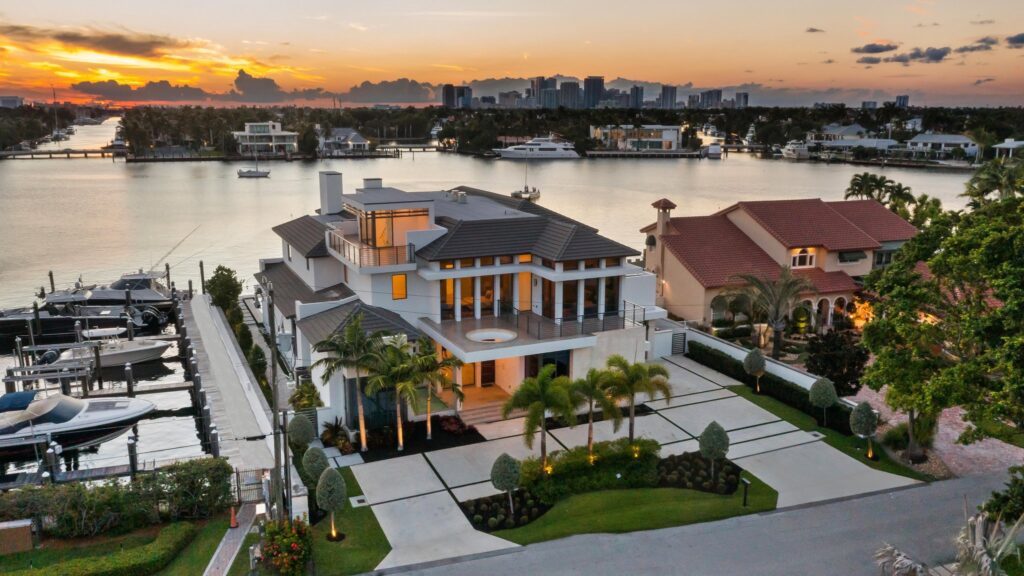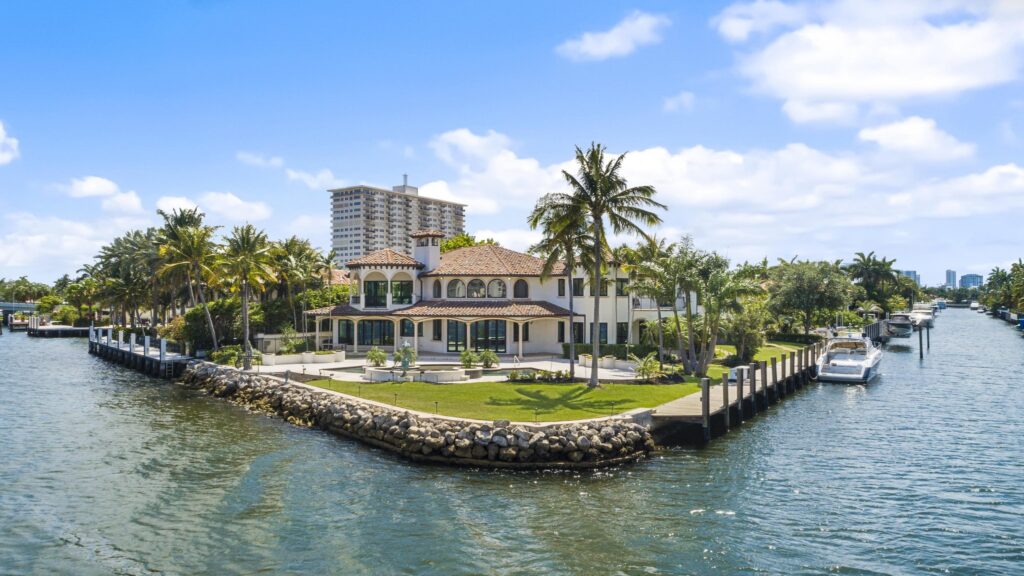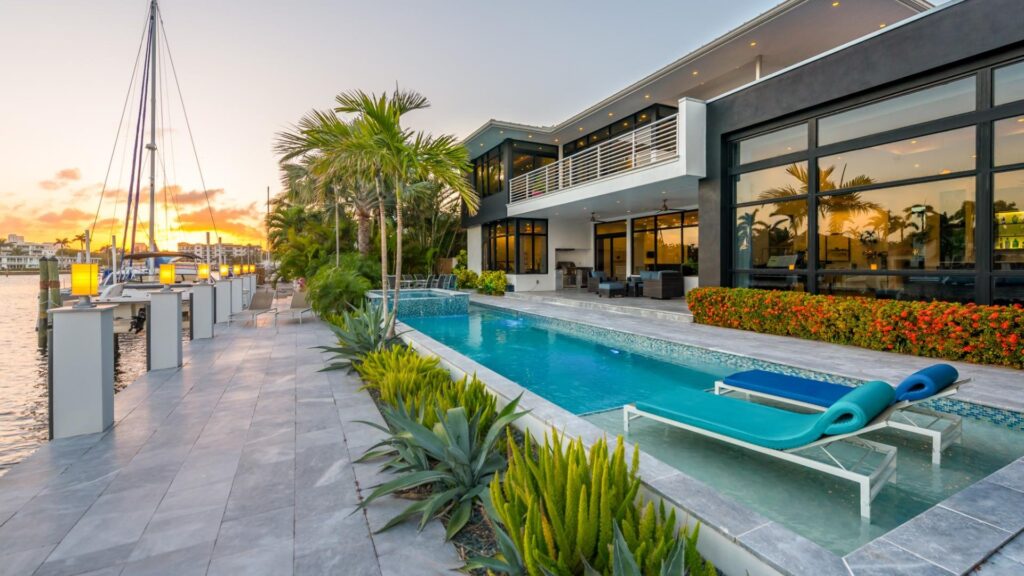

If you are buying a waterfront home in Fort Lauderdale or planning a dock upgrade, choosing between a boat lift and a fixed dock shapes how you use the property every day. The right answer depends on three things: your boat’s size, the canal behind the house, and what the City and County will let you build. This guide walks through each one, including the local rules most comparisons leave out.
Quick Answer: Boat Lift or Fixed Dock?
In Fort Lauderdale, the choice comes down to your boat’s size and how much saltwater exposure you want to avoid. A boat lift keeps the hull out of the water, which cuts marine growth and corrosion, and suits center consoles and other boats within residential lift capacity. A fixed dock suits larger sportfish boats and motoryachts, households with more than one boat, and canals where a lift is impractical. Many canal homes with enough frontage use both.
What Is a Boat Lift and How Does It Work?
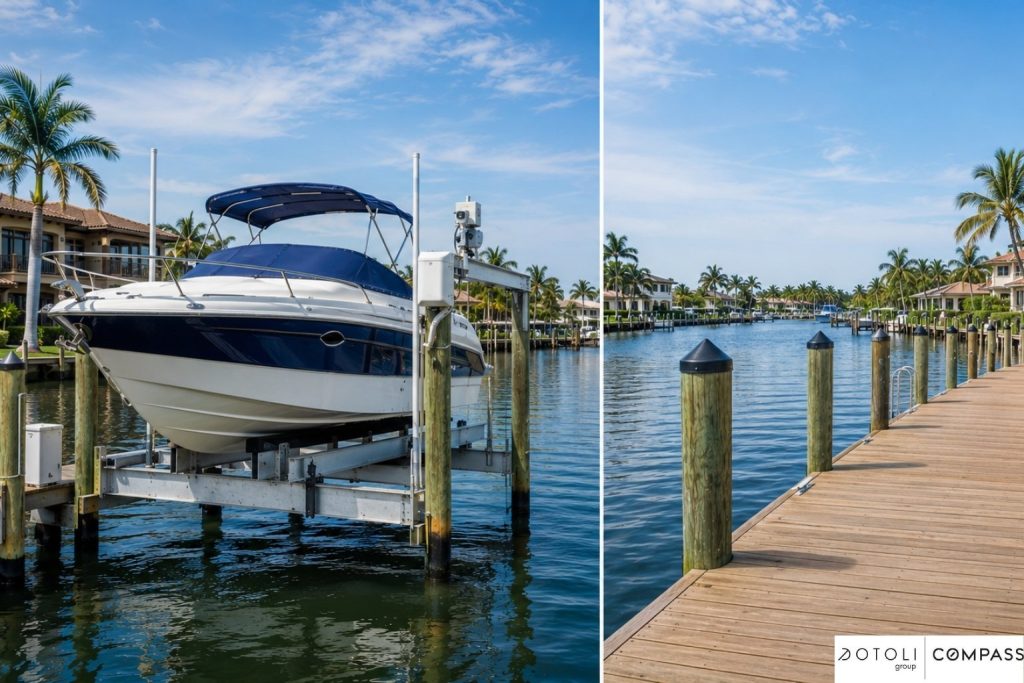
A boat lift is a mechanical system that raises your boat out of the water when you are not using it. Most residential lifts in Fort Lauderdale are four-post cradle lifts mounted on pilings, while some properties use elevator-style lifts attached to the seawall or floating drive-on platforms for smaller boats.
Electric motors with cables or hydraulics raise the boat above the waterline, where it stays until the next trip.
The benefit is straightforward. A hull that isn’t sitting in saltwater doesn’t collect marine growth, its metal fittings aren’t exposed to constant waterline corrosion, and it is protected from stray electrical current in the canal.
For owners who boat a few times a month, that means less bottom cleaning, less antifouling work, and a longer life for the boat.
What Is a Fixed Dock and How Does It Work?
A fixed dock is a stationary platform built over the water on pilings driven into the canal bottom. It provides a stable surface for boarding, storage, and line handling at any tide, and the boat ties alongside it and stays in the water.
Fixed docks in Fort Lauderdale are usually built with pressure-treated wood, composite, or concrete decking on wood, concrete, or steel pilings.
They range from a simple finger pier to a full wraparound dock with shore power pedestals, water hookups, and davits for a tender.
Fixed docks are the standard setup for sportfish boats, larger center consoles, and motor yachts, because those boats are often too heavy or too large for a residential lift.
How Does Your Boat’s Size Decide It?
Your boat’s size and weight set the clearest boundary. For a center console, flats boat, or bowrider in the range most residential lifts handle, a lift is usually the better choice in saltwater, because the savings on hull maintenance build up every year you own the boat.
Lift manufacturers and installers generally recommend choosing a lift rated 15 to 25 percent above your boat’s fully loaded weight, including fuel, water, and gear, according to Boatzon’s 2026 boat lift cost guide.
For sportfish boats and motoryachts, a fixed dock with good fenders and shore power is usually the practical answer. Lifts for heavy boats cost far more, need more water depth and structural support, and may not fit within the City’s limits on how far a structure can extend into the canal.
If you own two boats, a fixed dock for the larger one and a lift or davit for the tender or flats boat is a common combination on canal homes with enough frontage.
Our guide to what size boat you can keep at a Fort Lauderdale canal home covers the size question in more detail.
Does Your Canal Limit Which Option You Can Build?
In Fort Lauderdale, the canal often decides the question before the boat does.
Finger canals
Finger canals are the narrower residential waterways that branch off the main channels. A lift is usually possible on a finger canal for most residential boats, but narrow water can limit barge access during installation and leave less room to line a larger boat up with a lift.
Depth can be shallower too, which limits the size of boat a fixed dock can realistically hold. Our finger canal guide explains what to evaluate before buying one.
Wider and deeper canals
Wider, deeper canals give you more options, because both a lift and a fixed dock for a larger boat can fit. That flexibility is one reason deepwater canal homes attract buyers with bigger boats.
Never assume depth from a listing description. Our guide on how to verify water depth at a waterfront home shows how to confirm it before you commit.
The City’s limits on how far a lift or dock can extend
This rule most often decides what you can build. Under Section 47-19.3 of the City of Fort Lauderdale’s Unified Land Development Regulations, mooring structures, including docks and boat lifts but not mooring or dolphin piles, are limited in how far they can extend into the waterway, to 25 percent of the waterway’s width or 25 feet.
Going beyond that limit requires a waiver, which the City’s Marine Advisory Board typically reviews before it goes to the City Commission.
Two related rules matter on canal lots. Boats may not be docked in a way that extends past the property’s side setback lines projected into the water, so your frontage limits how much boat you can berth, not just the dock.
And davits or hoists on the lot are limited to a cross-section of one square foot and a height of six and a half feet above lot grade. On a narrow canal, these limits can rule out a large lift even when the boat itself would fit.
How Much Does Each Option Cost?
Costs vary widely with boat size, materials, water depth, and how hard the site is to reach, so the only reliable number is a written quote from a licensed marine contractor. The ranges below are published national figures, useful for budgeting before you get quotes.
Boat lift cost
Boatzon’s 2026 cost guide puts lift equipment at roughly $7,000 to $15,000 for lifts rated 7,000 to 10,000 pounds, $12,000 to $25,000 for 12,000 to 16,000 pounds, and $20,000 to $35,000 or more for lifts rated 20,000 pounds and up. Those figures are for the lift itself. Installation, pilings, electrical work, and permits are added on top.
Fixed dock cost
HomeAdvisor estimates that building and installing a piling dock runs about $20 to $40 per square foot nationally. Shore power, water, lighting, davits, and premium decking such as composite raise the total, and the dock’s over-water square footage also affects which state permit path applies (see the permits section below).
What pushes the price up in Fort Lauderdale
Several local conditions raise costs. Most canal installations need a barge, and narrow finger canals or low bridges can make barge access harder. Heavier lifts may need new pilings rather than attaching to existing ones. Electrical work for the lift motor and shore power adds its own line item.
And if the seawall needs repair, that work usually has to happen before or alongside the dock project, which can change the budget entirely. Our seawall replacement cost guide covers that side of the budget.
How Does Saltwater Affect Each Option?
Saltwater corrosion is the highest ongoing cost for any marine structure on a Fort Lauderdale canal, and the two options carry that cost in different places.
With a lift, the boat is protected, but the lift is not. Its cables, motor, cradle bunks, and frame sit in a saltwater environment all the time. Cables need regular inspection and replacement, motors need protective covers, and aluminum frames generally hold up better than steel.
With a fixed dock, the boat stays in the water and takes the exposure, while the dock’s own corrosion concentrates on the pilings, hardware, and framing. Composite decking avoids rot but does nothing for the pilings beneath it.
For a fuller picture of how salt affects every system on a canal property, read our guide to saltwater corrosion on Fort Lauderdale waterfront homes.
What Permits Do Boat Lifts and Docks Need in Fort Lauderdale?
Most dock and lift projects involve more than one agency. Requirements change and depend on the specific property, so confirm the current rules with a licensed marine contractor before you start.
City of Fort Lauderdale
New docks and lifts need a City building permit, and the project must meet the waterway, setback, and davit limits described above. Structures that exceed those limits need a waiver.
Broward County
Broward County regulates work in, under, and over surface waters, including docks, seawalls, boat lifts, piers, and pilings, through a General Environmental Resource License. The County describes this as a streamlined process that is usually completed within 7 to 10 days, according to its technical bulletin on docks and seawalls.
Florida DEP
Many private residential docks do not need an individual state permit. Under Florida DEP rules, a private dock with 1,000 square feet or less of total over-water area in a canal outside Outstanding Florida
Waters can qualify for an exemption, and DEP offers free online self-certification for most locations outside aquatic preserves, according to its South Florida dock permitting guide.
The 1,000 square feet includes the dock and everything attached to it, such as boat lifts, roofs, and boat canopies, so adding a lift or cover to an existing dock can push the project over the limit and require a permit.
U.S. Army Corps of Engineers
Depending on the waterway and project size, federal review by the Army Corps of Engineers may also apply. Your marine contractor will know whether your site needs it.
For a step-by-step look at the permit process, see our Fort Lauderdale dock permit guide.
Which Adds More Value at Resale?
Both a working boat lift and a well-kept fixed dock add value to a Fort Lauderdale waterfront home. What matters is which one the likely buyers for that property will want. A good four-post lift appeals to buyers who boat often and want to protect a smaller boat.
A deepwater fixed dock that can hold a large motoryacht attracts a different buyer, often one who already owns that boat and is shopping for a place to keep it.
The weak point at resale is any dock or lift in poor or undocumented condition. Rotting decking, failing pilings, frayed lift cables, a corroded motor or an addition that was never permitted all give buyers leverage to renegotiate.
The same goes for the seawall underneath. A solid dock on a failing seawall is still a problem, which is why our seawall inspection schedule is worth reviewing alongside any dock decision.
Which Option Is Right for You?
Choose a boat lift if your main boat is within residential lift capacity, you boat often and want less hull maintenance, and your canal width and depth leave room for a lift within the City’s limits.
Choose a fixed dock if your main boat is too large or heavy for a residential lift, you keep more than one boat, or your canal makes a lift impractical.
What to Check on an Existing Dock or Lift Before You Buy
When the home already has a dock or lift, check these items during your inspection period:
- Permits. Ask the seller for the permits for the dock, the lift and any additions, and confirm them with the City.
- Lift capacity and age. Find the lift’s rated capacity on its data plate and compare it with your boat’s loaded weight, then ask when the cables and motor were last replaced.
- Pilings and decking. Have a marine contractor inspect the pilings, framing and decking for rot, corrosion and movement.
- Electrical. Confirm the lift motor and shore power are on proper circuits and in working order.
- Seawall condition. Inspect the seawall the dock and lift depend on, because repairs there can affect both.
- Room to grow. If you plan to add a lift or a larger dock, ask a contractor whether it fits within the City’s extension and setback limits before you close.
Our guide to waterfront homes with private docks in Fort Lauderdale covers what buyers should look for in a dock-ready property.
Buying a Waterfront Home in Fort Lauderdale?
The dock on a waterfront property tells you a lot about how the whole home has been cared for, and whether it can handle the boat you own or plan to buy.
The Dotoli Group helps buyers judge canal depth, frontage, dock condition and seawall health before they make an offer. Contact us before you commit to a Fort Lauderdale canal property.